
Over the past decade, service-based businesses have changed dramatically. It’s no longer just about delivering great work; it’s about delivering it faster, more efficiently, and with full visibility into how every project impacts your bottom line. Whether you’re managing consulting projects, IT services, or field operations, today’s customers and internal teams expect real-time updates, seamless collaboration, and accurate forecasting.
But here’s the challenge: most businesses are still juggling with disconnected tools for project management, accounting, resource planning, and billing. This leads to manual work, delayed decisions, and missed revenue opportunities. To truly thrive, service organizations need more than just better tools; they need a unified way to run their businesses.
That’s where Certinia steps in!
Formerly known as FinancialForce, Certinia is a powerful, Salesforce-native platform that combines Professional Services Automation (PS Cloud) and Enterprise Resource Planning (FM Cloud) and Customer Success (CS Cloud). It brings your front office and back office together, so sales, service, and finance teams are always aligned and working with real-time data.
With Certinia, service firms can:
- Streamline project delivery from opportunity to invoice
- Improve financial control with accurate revenue recognition and forecasting
- Optimize resources, timelines, and client experiences
- Make faster, more confident business decisions
If you’re looking to simplify operations, scale with confidence, and stay ahead in the services game, Certinia is the platform built to make that happen.
Table of Contents
ToggleWhat is Certinia and How It Transforms Services Businesses?
Certinia (formerly FinancialForce) is built for services businesses that need precision, speed and control across every client engagement and financial touchpoint. It unifies core functions like project delivery, financial management, and customer success, giving businesses a real-time, unified view of operations.
Key Drivers of Transformation with Certinia Implementation
-
A Single Source of Truth:
By implementing Certinia, businesses eliminate data silos. Sales, finance, delivery, and customer success teams all work from the same real-time data, leading to better decisions and fewer miscommunications. -
Real-Time Visibility Across the Business:
Certinia has a Salesforce-native architecture, enabling live dashboards and reporting. Whether it’s project progress, resource utilization, or financial health, leaders get immediate insights for faster, smarter action. -
Enhanced Collaboration and Workflow Integration:
Teams can collaborate seamlessly across sales, service, and finance, using shared tools, automated workflows, and common data sets. This reduces manual work and increases efficiency.
Outcomes of Certinia CRM and ERP Implementation
-
Faster Project Delivery:
Clear resource planning, real-time updates, and automated workflows streamline execution. -
Improved Profitability:
Better forecasting, time tracking, and billing accuracy ensure optimized margins. -
Scalable Growth:
With a unified system in place, businesses can expand services and teams without worrying about disconnected tools or redundant processes.
How to Prepare for Certinia Implementation
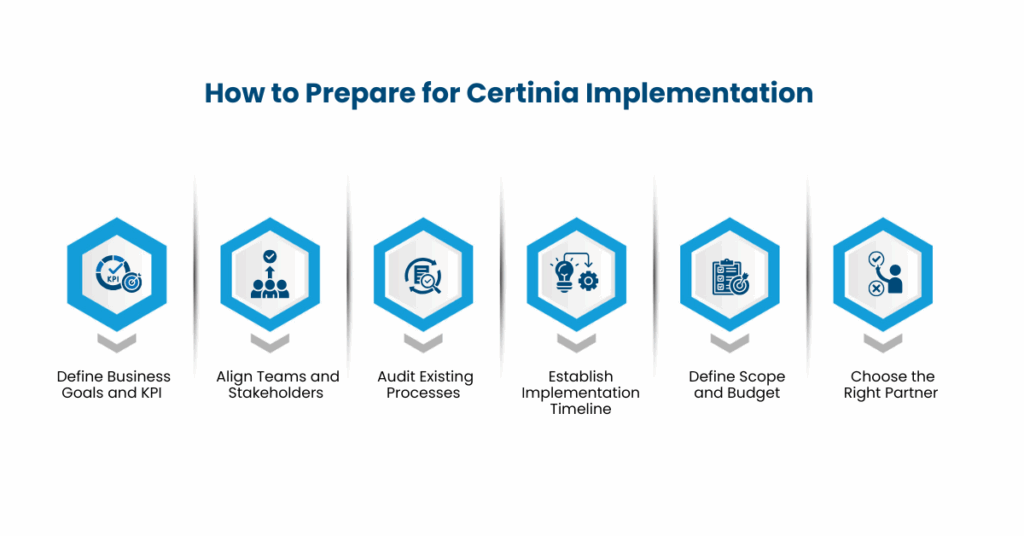
A successful Certinia implementation starts long before the first configuration. It begins with preparation, aligning your goals, your teams, and your processes. This checklist outlines the critical steps you need to take to set the foundation for a smooth, scalable rollout of Certinia PS, FM, and CS Cloud.
-
Define your business goals and KPIs
Start by clearly articulating what you want to achieve with each Certinia module. Are you looking to accelerate project delivery, improve cash flow visibility, or enhance customer service operations? These KPIs will guide every decision throughout the implementation. -
Align your internal teams and stakeholders
Bring together all relevant stakeholders early, project sponsors, finance leads, service operations, and IT. Establish who will make decisions, who will drive process changes, and who will ensure adoption. This internal alignment is key to avoiding roadblocks later. -
Audit existing systems and processes
Take a close look at your current workflows, tools, and data. Identify inefficiencies, redundancies, and pain points that Certinia should address. This step helps ensure the system you implement is solving real problems, not just replicating outdated processes on a new platform. -
Establish a phased implementation timeline
Break down the implementation into manageable stages,starting from planning, through configuration and training, to go-live and post-launch support. Set realistic deadlines and align them with your internal availability and key business cycles. -
Define the scope and budget
Clarify which functionalities are essential from the start and what can be phased in over time. Align your budget with the expected level of customization, training, integration, and support. This helps you stay focused and avoid scope creep. -
Choose the right implementation partner
Your partner should not only be experienced in Certinia implementations but also understand your industry and operations. They will guide the configuration, integrations, data migration, and testing while helping your teams embrace the new system. -
Develop a change management strategy
Technology alone won’t drive transformation; people using technology will. Prepare your staff for the change with transparent communication, regular updates, and tailored training. Help them understand why this change matters and how it benefits their day-to-day work.
6 Key Questions to Ask Before Implementing Certinia
Before diving into your Certinia implementation, it’s critical to assess where you stand today and what you’re aiming to achieve. These foundational questions will help shape your PSA/ERP system rollout for long-term value and success.
-
What business challenges are we solving with Certinia?
Start with clear goals. Are you trying to improve project delivery timelines, gain real-time financial insights, or boost customer success outcomes? Identifying specific challenges ensures your Certinia implementation plan stays focused and aligned with measurable business objectives. -
How mature is our current PSA/ERP system?
Evaluating the current state of your systems helps determine which Certinia modules including PS Cloud, FM Cloud, or CS Cloud, will deliver the most impact. This also informs how your new solution will complement or replace existing tools. -
Who are the key stakeholders involved in the implementation?
Every successful Certinia implementation requires input and alignment across departments. Involve leaders from services, finance, operations, and IT early in the process to define business needs, track progress, and drive adoption. -
What level of customization and integration do we need?
Certinia is flexible, but you need to determine where your workflows require customization or integration with other platforms like Salesforce, ERP, or legacy systems. This assessment guides the scope of Certinia integration and ensures smooth implementation. -
Are we ready to adopt best practices or do we need tailored workflows?
While Certinia offers strong out-of-the-box capabilities, some organizations may need tailored processes to match their operations. Deciding this early helps avoid delays and keeps the CRM implementation roadmap realistic. -
Is our data migration plan in place?
Data is at the core of every CRM and ERP system. Before go-live, assess data quality, identify key sources, and build a clear data migration plan. This includes mapping, cleansing, and validating data to ensure your Certinia platform launches with accuracy and confidence.
Understanding Certinia’s Integration with Salesforce – What You Need to Know
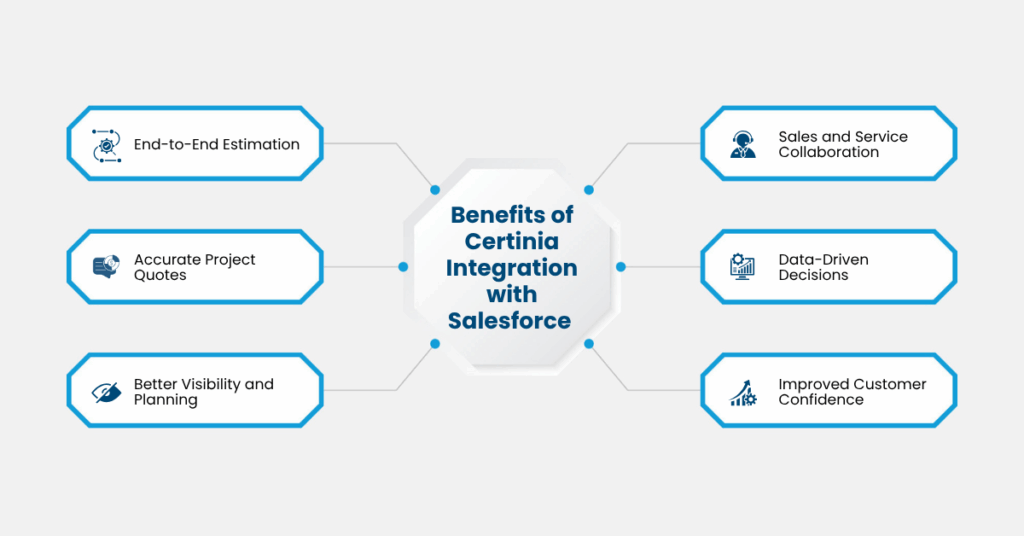
Certinia is natively built on the Salesforce platform, offering service businesses a tightly connected ecosystem for sales, delivery, and finance. One standout example of this integration is how Certinia Services Estimator connects seamlessly with Salesforce CPQ (Configure, Price, Quote), bridging the gap between estimation and quoting with zero manual handoffs. Explore more about Services Estimator here.
Here’s how this integration works and why it matters:
-
End-to-End Estimating and Quoting
With the Services Estimator, Salesforce CPQ connector, sales and delivery teams can collaborate in real time. This two-way sync reduces redundancy and speeds up the quote-to-delivery process. -
Faster, More Accurate Quotes
No more delays waiting for multiple teams—project estimates are instantly available for quoting, making it easier to move prospects through the sales funnel. -
Better Project Visibility and Planning
Understand timelines, costs, and resource needs upfront. This clarity helps both sales and delivery teams plan smarter and reduce surprises during execution. -
Aligned Sales and Services Teams
Everyone works off the same data, no miscommunication, no rework. From the first conversation to project kickoff, your teams are aligned. -
Data-Driven Sales Decisions
Quotes are built on real-time project data, giving leaders confidence in pricing, profitability, and delivery timelines. -
Elevated Customer Confidence
When internal teams are in sync, projects run smoother, and that directly translates to happier, more satisfied clients.
How Certinia and AblyPro Help You Streamline Project Management, Finance, and Customer Success
PS Cloud (Professional Services Cloud)
Manage end-to-end service delivery, from estimation and planning to resource allocation and billing. What You Achieve:- Plan projects and allocate resources based on real-time data.
- Track progress, costs, and profitability at every stage.
- Seamlessly connect Services Estimator and Salesforce CPQ for accurate, automated quoting.
FM Cloud (Financial Management Cloud)
Simplify and automate core finance functions including billing, revenue recognition, and financial reporting. What You Achieve:- Automated billing, revenue recognition, and expense tracking.
- Gain instant visibility into cash flow, margin, and financial health.
- Speed up financial closing and maintain audit readiness.
CS Cloud (Customer Success Cloud)
Track customer health, manage success plans, and drive renewals with real-time insights.- Monitor customer health and service milestones post-project.
- Align customer goals with delivery and financial performance.
- Build proactive success plans and drive higher renewals.
Where AblyPro Comes In
- We configure estimation templates and automate quote-to-project handoffs.
- We customize financial workflows and reporting dashboards for real-time visibility.
- We align customer success KPIs with delivery and finance goals.
- We integrate your PSA, FM, and CS Clouds with Salesforce CPQ and Services Estimator, ensuring a connected experience from sales to renewal.
Tips for Better Revenue Recognition and Forecasting
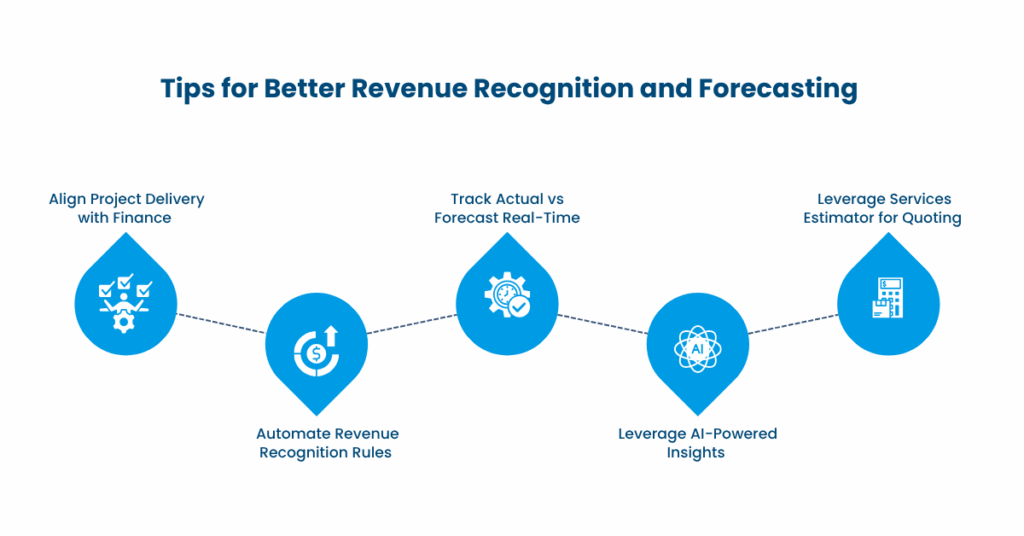
Certinia, with its native Salesforce integration, gives service businesses the real-time visibility and control needed for accurate revenue recognition and forecasting. Here’s how to make the most of it:
-
Align project delivery with finance
Use Certinia PSA (Professional Services Automation) to ensure delivery milestones, billing events, and revenue schedules are always in sync. -
Automate revenue recognition rules
Certinia FM Cloud supports ASC 606/IFRS 15 compliance, allowing you to automate complex revenue recognition processes based on performance obligations. -
Track actuals vs. forecasts in real time
With dashboards powered by Certinia CS Cloud, compare forecasted revenue against actuals and spot variances early to adjust plans. -
Leverage AI-driven insights
Integrate Salesforce Einstein AI to predict revenue based on pipeline, project progress, and resource utilization—turning data into forward-looking decisions. -
Use Services Estimator for accurate quoting
By building precise project estimates upfront, you lay the groundwork for more predictable revenue flows and fewer surprises later. With the right implementation partner like AblyPro, you not only set up the tools—you also ensure they’re aligned with your processes to drive accurate, timely, and compliant revenue recognition.
10 Signs Your Enterprise Needs Certinia Managed Services
Recognizing when to bring in a managed services partner for Certinia can help you regain control and accelerate results. Here are ten clear indicators:
Inconsistent reporting across departments
Struggling to get a single source of truth? Disconnected data can stall insights and decisions.
Manual project/resource tracking
If your teams still rely on spreadsheets to manage projects and resources, it’s time for automation.
Delayed billing and revenue recognition
Misaligned systems and workflows often lead to invoicing errors and missed revenue timelines.
Lack of integration between sales and delivery
When sales commitments don’t align with delivery capacity, customer satisfaction and margins suffer.
Low user adoption or system performance issues
A poorly implemented platform can slow teams down and increase resistance to change.
Compliance concerns
Managing ASC 606/IFRS 15 or industry-specific regulations manually increases risk.
Limited visibility into business KPIs
Without real-time dashboards, leadership can’t track performance or course-correct quickly.
High IT maintenance costs
Continuous patching, troubleshooting, and updates can drain resources without improving ROI.
Inability to scale operations
As your business grows, Certinia should scale with you—not become a bottleneck.
You’re not leveraging the full Certinia roadmap
If you’re only using a fraction of what Certinia offers, you’re leaving value on the table.
Why PSA + ERP Combined = Total Services Business Control
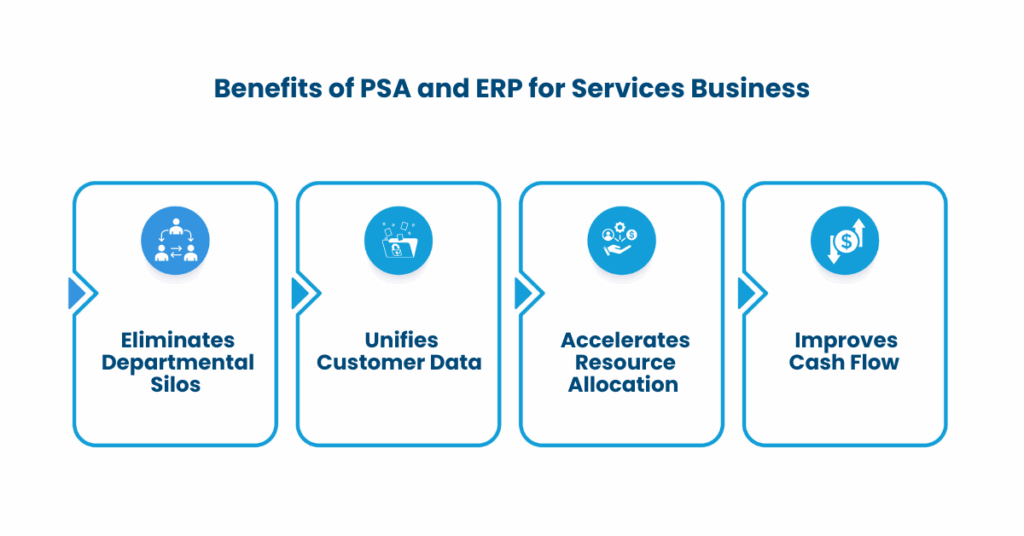
A unified PSA + ERP model isn’t just convenient; it’s transformative for service-centric enterprises.
Here’s how:
-
Eliminate silos between departments
By unifying your front-office (Sales, Project Management) and back-office (Finance, Accounting), Certinia removes the traditional handoff delays and data mismatches. Teams collaborate in real-time, reducing rework and improving operational flow across the entire services lifecycle. -
Unify data across projects, people, and profits
A single platform means all your project timelines, resource utilization, and financials are connected. This holistic view helps leadership understand which projects are most profitable, where resources are underutilized, and how each decision impacts the bottom line. -
Accelerate decisions and resource allocation
Real-time dashboards and automated alerts empower managers to act fast—whether reallocating consultants to high-priority accounts, adjusting project timelines, or refining forecasts. Faster decisions mean better client delivery and higher margins. -
Improve cash flow, compliance, and client satisfaction
Integrated billing and revenue recognition ensure accurate invoicing aligned with project milestones. This reduces delays and disputes, helps meet compliance standards, and ensures clients receive timely updates, building trust and long-term relationships.
Top Reasons to Choose a Salesforce, Native ERP and PSA Like Certinia
Certinia’s deep integration with Salesforce offers a strategic advantage, especially for services businesses that live inside the Salesforce ecosystem:
-
Native integration, no third-party connectors needed
Certinia is built directly on the Salesforce platform, eliminating the need for external connectors or custom integrations. This tight alignment ensures a seamless experience across your CRM, PSA, and ERP processes,reducing complexity, saving integration costs, and minimizing risk. -
Real-time updates across CRM and ERP
Changes made in Salesforce, such as updates to opportunities, accounts, or service engagements, are instantly reflected in Certinia. This real-time sync ensures that your teams in sales, services, and finance are always working from the same up-to-date data, improving collaboration and reducing manual follow-ups. -
Enhanced security, scalability, and user experience
With Certinia operating on Salesforce’s secure infrastructure, you get enterprise-grade security controls, audit trails, and compliance features built-in. The intuitive interface and consistent user experience also make it easier to onboard teams, improve adoption, and scale confidently as your business grows. -
Ecosystem advantage
Certinia users benefit from access to Salesforce’s vast ecosystem, including AppExchange applications, native automation capabilities, and AI tools like Einstein. This means you can enhance your workflows with minimal custom development, introduce AI-driven insights, and continuously innovate without platform lock-in. -
Lower total cost of ownership (TCO)
Thanks to native integration, faster deployment cycles, and fewer IT dependencies, organizations using Certinia often realize a faster time-to-value. Reduced maintenance overhead, higher user productivity, and built-in scalability result in long-term cost efficiencies that non-native platforms struggle to match.
Wrapping Up
In the services landscape, success depends on more than just delivering great work; it requires total visibility, seamless collaboration, and systems that can scale with your business. Certinia, as a Salesforce-native platform, offers a unified foundation by integrating your sales, delivery, finance, and customer success functions into one ecosystem.
From streamlined project management with PS Cloud and accurate forecasting with FM Cloud, to proactive client success with CS Cloud, Certinia enables smarter decisions, better margins, and stronger customer outcomes. And with powerful tools like the Services Estimator and deep Salesforce integration, it eliminates manual effort and accelerates your quote-to-cash lifecycle.
But technology alone isn’t enough. That’s where AblyPro comes in. As an experienced implementation and managed services partner, AblyPro ensures that Certinia is configured to fit your processes, integrated the right way, and continuously optimized for evolving needs.
Whether you’re looking to improve revenue recognition, gain real-time financial insights, or scale operations with confidence with Certinia, AblyPro is the guide to help your services business run smarter, faster, and more profitably.
Ready to unlock the full potential of Certinia? Let’s build the foundation for your next phase of growth, together.
Author

AVP, AblyPro

Murali is the AVP – Certinia at AblyPro with 12+ years of experience in handling complex Certinia and Salesforce applications, implementations, configurations, and customizations. At AblyPro, he has been the pillar of all the Certinia PSA and ERP project deliverables, ranging from design to implementation, project management, and resource management. With years of practical knowledge and expertise in this industry, Murali supports the sales team in strategizing customer solutions to meet the actual business needs of the clients. Murali is a dynamic and experienced professional with multiple Certinia and Salesforce certifications, helping businesses to technically strive in this ever-changing landscape.