AI is now part of everyday enterprise operations. Yet many teams still struggle with one basic question:
Are we using AI to assist with work or move work forward?
Enterprise technology is entering a new phase, one where systems don’t just analyze data or automate steps but actively participate in how work gets done. Across CRM, service, and operations, leaders are recognizing that the next leap forward isn’t faster tools, but systems that can think, decide, and act within business workflows.
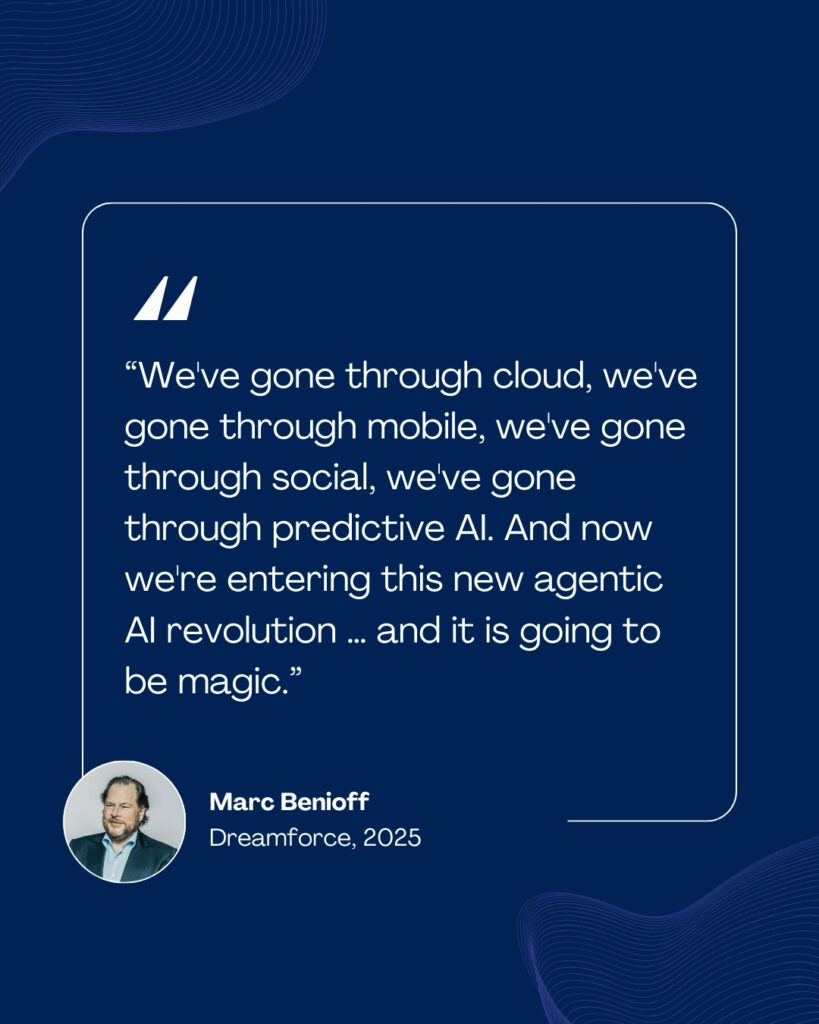
This shift is reshaping how leaders think about AI inside core business workflows. Salesforce CEO Marc Benioff recently captured this moment clearly when describing what comes next:
However, one question sits at the heart of the difference between AI agents and Agentic AI! They sound similar, but they solve very different problems. Understanding this distinction helps leaders set realistic expectations for automation, productivity, and decision-making across Customer Service, Field Service, and Certinia-powered operations.
Let’s break it down, simply.
Table of Contents
ToggleAI Agents: Reactive Helpers Inside Workflows
AI agents are designed to help teams complete specific tasks, but they only act after something triggers them. That trigger could be a user action, a system event, or a predefined workflow.
Think of AI agents as helpful assistants who are always available but only step in when asked.
For example, in Salesforce Service Cloud, an AI agent may suggest a response after an agent opens a case or clicks into an email. The agent doesn’t decide which case to prioritize or when to act; it simply helps once the work has already started. Certinia AI agents are built to automate real operational workflows directly inside PS Cloud and CS Cloud.
These agents are valuable. They reduce manual effort. They speed up individual tasks. They improve accuracy within a defined scope. Twenty-three percent of respondents report their organizations are scaling an agentic AI system somewhere in their enterprises (that is, expanding the deployment and adoption of the technology within a least one business function), and an additional 39 percent say they have begun experimenting with AI agents.
In simple terms, AI agents assist with work. They don’t manage it.
Agentic AI: Proactive and Autonomous Across Systems
Agentic AI works differently from traditional automation or task-based AI. It doesn’t wait for someone to click a button, open a case, or trigger a workflow. Instead, it continuously observes what’s happening across systems, data, and processes in real time.
It understands context- how customer interactions, service history, project data, and operational signals connect to one another. Based on that understanding, it takes the first step on its own.
This is why Agentic AI is best viewed as a system-level partner, not a task assistant.
Rather than reacting to events after they happen, Agentic AI proactively supports teams by identifying risks early, initiating corrective actions, and guiding decisions across platforms like Salesforce and Certinia. It works quietly in the background to keep operations moving in the right direction without constant human intervention.
How Agentic AI Differs from AI Agents in Real Work
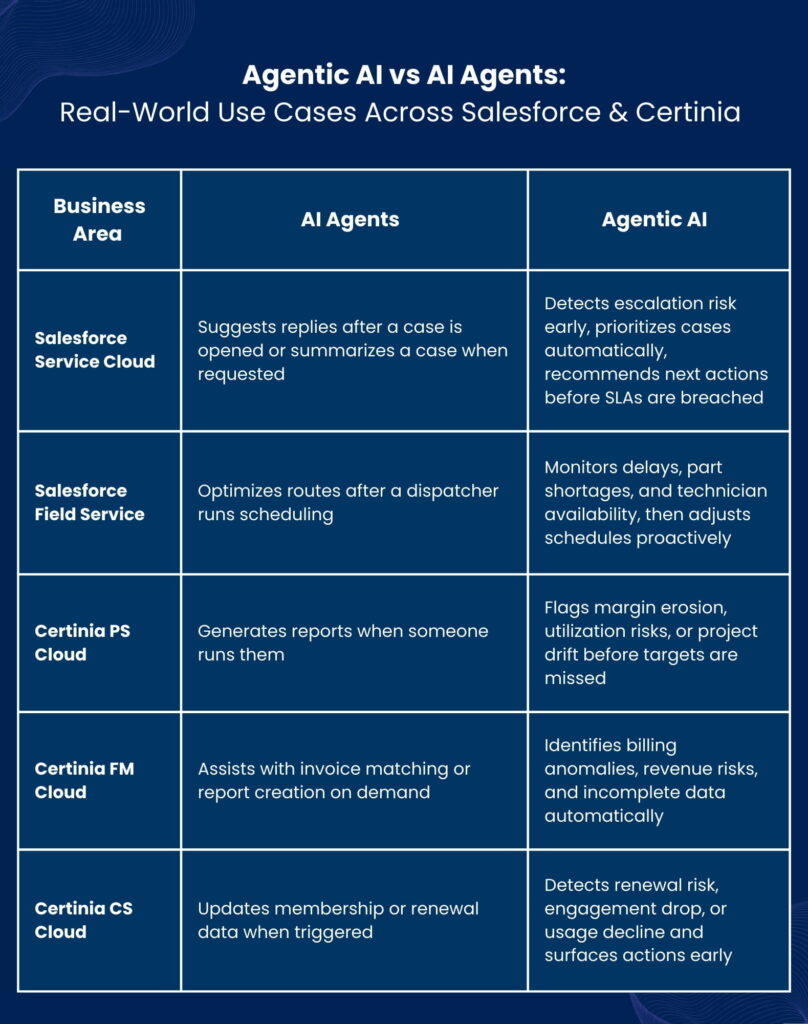
AI agents and Agentic AI solve very different problems, and that difference becomes clear once you look at how work actually unfolds inside an enterprise.
AI agents step in after work has already started, once a case is opened, a report is run, or a workflow is triggered. Their job is to help someone finish faster. They reduce manual effort, improve accuracy, and save time at the point of execution.
Agentic AI doesn’t wait for work to begin. It watches how activity builds across teams, tools, and data. It connects signals from multiple systems and coordinates action before friction turns into delays, escalations, or missed targets.
This difference matters because most enterprise challenges don’t sit in one inbox or one screen. They span Salesforce Service Cloud, Field Service, and Certinia at the same time. A delayed response in Service Cloud can impact field schedules. A project slipping in Certinia PS can affect billing in FM Cloud. A renewal risk in CS Cloud often reflects long before anyone opens a report.
That’s why the contrast between AI agents and Agentic AI becomes most visible in real operations, not in theory. And it’s exactly what the comparison below brings to life.
Why Data Is the Foundation for Both AI Agents and Agentic AI
Whether you’re using AI agents or moving toward Agentic AI, the outcome depends on how complete, consistent, and trustworthy your data is.
AI agents rely on clean data to perform specific tasks once they’re triggered. If customer records are duplicated, case histories are incomplete, or project data is fragmented, even a helpful AI suggestion can miss the mark.
Agentic AI raises the stakes even further. Because it operates continuously and initiates actions on its own, it needs a much stronger data foundation. It must accurately understand how customer interactions, service activity, project performance, financials, and operational signals connect across Salesforce and Certinia. If that context is broken, the AI doesn’t know what to prioritize, when to act, or which decision is right.
This is exactly where AblyPro supports organizations preparing for AI at scale.
AblyPro helps Salesforce and Certinia teams by:
Cleaning and standardizing data
Removing inconsistencies, so records follow the same structure, naming conventions, and logic across systems.
Eliminating duplicates and fragmented records
Ensuring customer, project, and financial data exists in one trusted version, not multiple conflicting copies.
Fixing broken, unused, or overloaded fields
Simplifying data models so AI understands what each field represents and how it should be used.
Aligning Salesforce and Certinia objects
Connecting data across Customer Service, Field Service, PS, FM, and CS Cloud so context flows seamlessly between teams.
Mapping data to real operational workflows
Making sure data reflects how work happens and not how systems were originally configured.
Establishing strong data governance
Defining validation rules, ownership, and standards that keep data accurate, consistent, and reliable as teams scale and processes evolve. To learn more, read our blog Building the Foundation of Agentic AI with Data Governance
With clean data and proper governance in place, AI stops guessing and becomes clear, dependable, and genuinely helpful.
Final Thoughts
This blog walked through a simple but important distinction:
AI agents assist with individual tasks after work have already begun. Agentic AI supports the business earlier by coordinating action across systems and preventing friction before it shows up.
We explored how this difference plays out across Customer Service, Field Service, and Certinia PS, FM, and CS Cloud, and why Agentic AI represents a shift from reactive support to proactive operations.
But no AI model can deliver that value without the right foundation. Clean data, consistent structures, and strong governance are what turn AI from a feature into a true operational advantage.
Get your data ready for AI that works. Talk to AblyPro.
Author

AVP, AblyPro

Murali is the AVP – Certinia at AblyPro with 12+ years of experience in handling complex Certinia and Salesforce applications, implementations, configurations, and customizations. At AblyPro, he has been the pillar of all the Certinia PSA and ERP project deliverables, ranging from design to implementation, project management, and resource management. With years of practical knowledge and expertise in this industry, Murali supports the sales team in strategizing customer solutions to meet the actual business needs of the clients. Murali is a dynamic and experienced professional with multiple Certinia and Salesforce certifications, helping businesses to technically strive in this ever-changing landscape.