Agentic AI is often described as “AI that takes initiative.” That sounds powerful, but it leaves a critical piece.
Agentic AI doesn’t act on instinct. It acts on context. And that context comes from data.
To decide what to do next, Agentic AI must see what is happening across customers, projects, service activity, and operations at the same time. When that data is complete and connected, AI understands context. When it isn’t, the AI sees only fragments that may lead to poor outcomes.
Fragmented data leads to predictable problems- alerts arrive too late, priorities are set incorrectly, and important actions are missed altogether. This is because AI simply doesn’t have the full picture. Clean data only works when everyone trusts it. Learn how a single source of truth brings alignment across teams in Build a Smarter Business with a Single Source of Truth
This blog breaks down, in simple terms, why clean, consistent data gives Agentic AI the context it needs to work effectively. Using practical examples from Salesforce Service Cloud, Field Service, and Certinia, we’ll show how data quality directly impacts how Agentic AI observes, decides, and acts, without the jargon.
Table of Contents
ToggleSetting Up Your Data for Agentic AI That Acts with Confidence
Once Agentic AI understands patterns across systems, the next question becomes practical:
How do you prepare your data so the AI can actually see those patterns clearly?
This step is often underestimated. But it’s where most Agentic AI initiatives succeed or fail.
For enterprises running on platforms like Salesforce and Certinia, Agentic AI depends on consistent, connected, and trusted data. A customer project, or financial record, should tell the same story across every system.
Here’s how organizations typically move from fragmented data to AI-ready data.
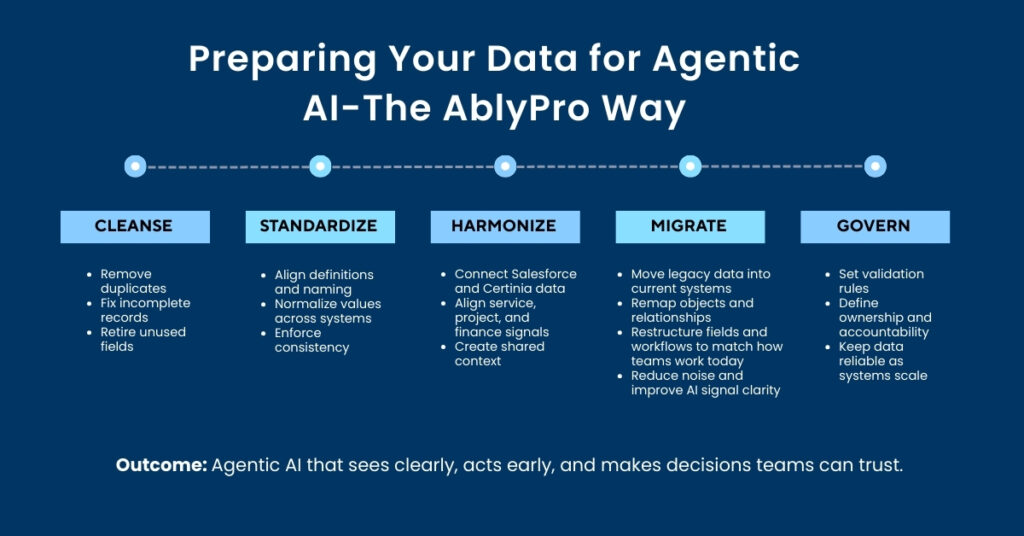
1. Start by Cleaning What Already Exists
For most enterprises, customer records exist in multiple versions. Case histories are incomplete. Project fields fall out of date. Financial data tells a different story than operations.
Common issues include:
- Duplicate customers and accounts
- Incomplete or fragmented case histories
- Projects with outdated or unused fields. Learn more
- Financial data that doesn’t align with operational reality
When Agentic AI sees conflicting versions of the same data, it doesn’t know what to trust.
Data cleaning gives it clarity, so it can act early and act correctly.
In practice, it means:
- Merging duplicate records into one accurate view
- Filling critical data gaps
- Removing unused or misleading fields
- Validating that key information is current and consistent
This gives Agentic AI a single, trusted source of truth. With that foundation, it can recognize patterns clearly, prioritize correctly, and take action before small issues become real problems.
2. Standardize Data So Systems Speak the Same Language
Cleaning data removes errors, while standardization removes confusion by ensuring information is interpreted the same way across systems.
In most enterprises, different teams describe the same thing in different ways. A “high-priority case” in Service Cloud may not match a “high-risk customer” in CS Cloud or a “critical project” in Certinia PS. Humans can interpret these differences. Agentic AI cannot.
When labels, values, and definitions don’t line up, the AI struggles to compare signals. It may treat similar situations as unrelated or miss patterns entirely.
Standardization focuses on:
- Using common naming conventions across teams
- Aligning picklist values and status labels
- Defining risk, priority, health, and urgency the same way everywhere
- Applying consistent formats for dates, currencies, and measurements
When data follows the same rules across systems, Agentic AI can interpret signals correctly. It no longer must guess what “urgent” or “at risk” means. It can compare situations confidently and respond with precision.
3. Harmonize Data Across Salesforce and Certinia
Harmonization is where Agentic AI begins to behave like an intelligent system, not just a smart tool.
This is the point where data from different platforms stops living in isolation and starts working together. When customer records, service activity, project data, and financial information are correctly connected, Agentic AI can understand how one action affects another.
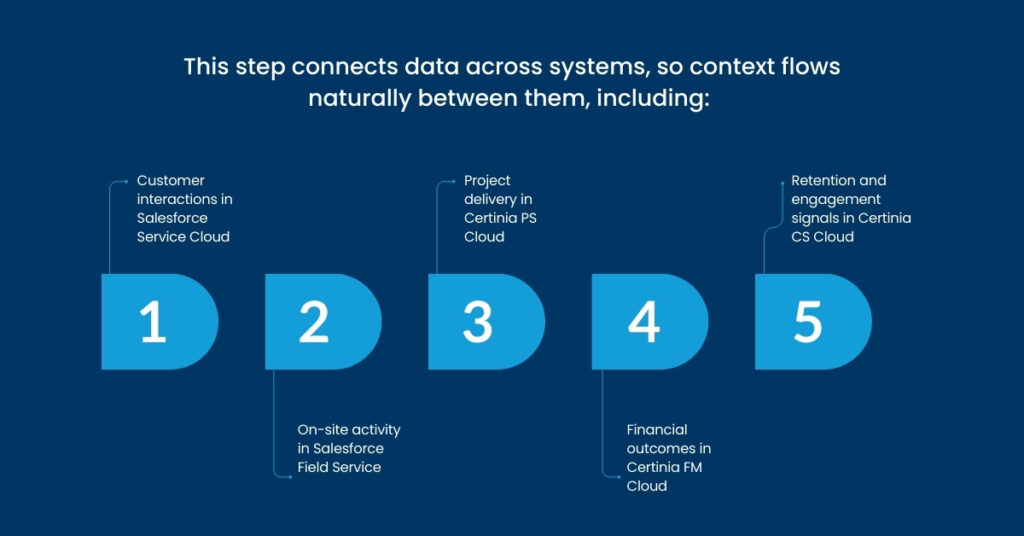
This step connects data across systems, so context flows naturally between them, including:
- Customer interactions in Salesforce Service Cloud
- On-site activity in Salesforce Field Service
- Project delivery in Certinia PS Cloud
- Financial outcomes in Certinia FM Cloud
- Retention and engagement signals in Certinia CS Cloud
When data is harmonized, Agentic AI can see cause and effect across the enterprise. For example, a delayed field visit connects to rising case volume, which links to a slipping project timeline and eventually shows up as billing risk.
4. Migrate and Restructure Data to Match Real Work
Many organizations are still working with data models created for older ways of working. Over time, new fields get added, processes change, and systems become harder to use than the work they’re meant to support.
Agentic AI works best when data matches how teams operate today, not how systems were designed years ago. When data reflects real workflows, the AI can focus on what matters and act with confidence.
That often means:
- Migrating data into cleaner, simpler structures
- Re-mapping objects and relationships to reduce friction
- Removing unnecessary complexity from configurations
- Aligning data models with current workflows and decisions
This step reduces noise. It helps Agentic AI focus on the signals that matter most, instead of getting distracted by outdated fields or irrelevant relationships.
5. Govern Data to Keep It Reliable
Once data is clean, standardized, harmonized, and migrated, governance ensures it stays accurate and consistent over time. Without governance, even the best-prepared data can degrade as teams grow, and processes change.
Effective data governance for Agentic AI includes:
- Setting validation rules to prevent incorrect data from entering the system.
- Defining ownership and accountability for maintaining data quality across teams.
- Monitoring and auditing data to maintain consistency.
- Establishing update protocols to ensure that changes reflect current workflows
Good governance keeps data trustworthy, enabling Agentic AI to continuously detect patterns, prioritize actions, and support decisions without hesitation. It’s the final layer that locks in clarity and reliability, so your AI always has a dependable source of truth.
How Clean and Connected Data Powers Agentic AI Context
Once your data is clean, standardized, harmonized, migrated, and governed, Agentic AI can do more than just process information; it can understand it. Clean data provides the context that AI needs to see patterns, make connections, and act confidently.
For Agentic AI, context comes from the ability to connect multiple signals across systems. When these signals are consistent and reliable, Agentic AI can answer questions like:
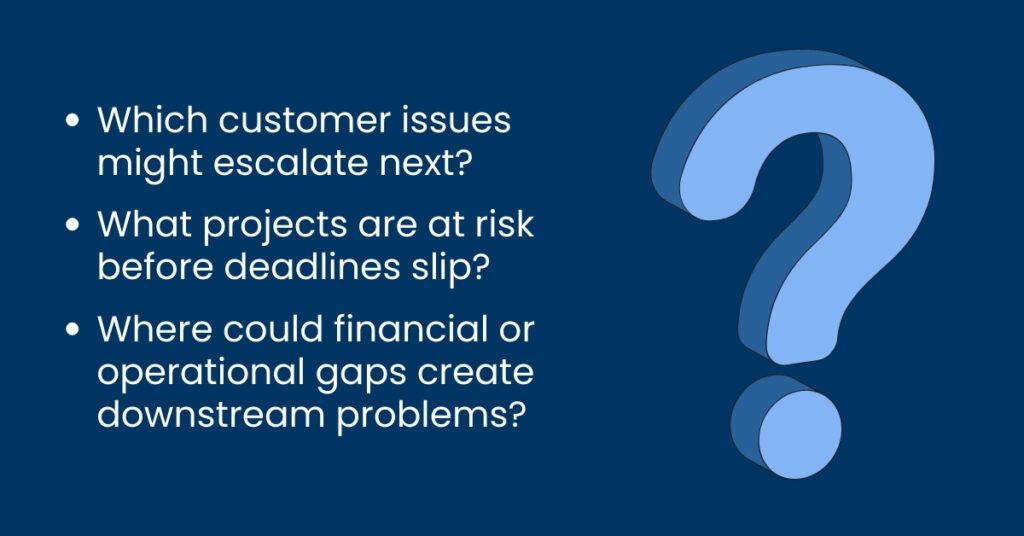
Agentic AI needs to understand how different parts of your business connect. Clean, harmonized data gives it the context to do that. Without it, AI sees only isolated events.
- Connected data shows cause and effect: A spike in support cases combined with delayed field visits can signal a project risk before it becomes critical.
- Consistent definitions prevent confusion: If “high priority” means the same in Service Cloud, Certinia PS, and CS Cloud, AI can accurately recognize patterns and act wisely.
- Reliable data enables proactive action: AI can flag risks, suggest next steps, or even trigger automated actions, before issues escalate.
Think of clean, harmonized data as a “map” for AI. With it, Agentic AI sees the full picture, understands context, and becomes a true decision-making partner.
Wrapping Up
Agentic AI can only act confidently when it has a complete, connected view of your business. Clean, standardized, and harmonized data gives it the context to spot patterns, flag risks early, and suggest or take the right actions. Without it, AI sees fragments and hesitates.
Start with clear, reliable data today and empower your AI to make smarter, faster decisions. Connect with experts to learn how.
Author

AVP, AblyPro

Murali is the AVP – Certinia at AblyPro with 12+ years of experience in handling complex Certinia and Salesforce applications, implementations, configurations, and customizations. At AblyPro, he has been the pillar of all the Certinia PSA and ERP project deliverables, ranging from design to implementation, project management, and resource management. With years of practical knowledge and expertise in this industry, Murali supports the sales team in strategizing customer solutions to meet the actual business needs of the clients. Murali is a dynamic and experienced professional with multiple Certinia and Salesforce certifications, helping businesses to technically strive in this ever-changing landscape.