You went live. Champagne was popped. The AI system is up and running.
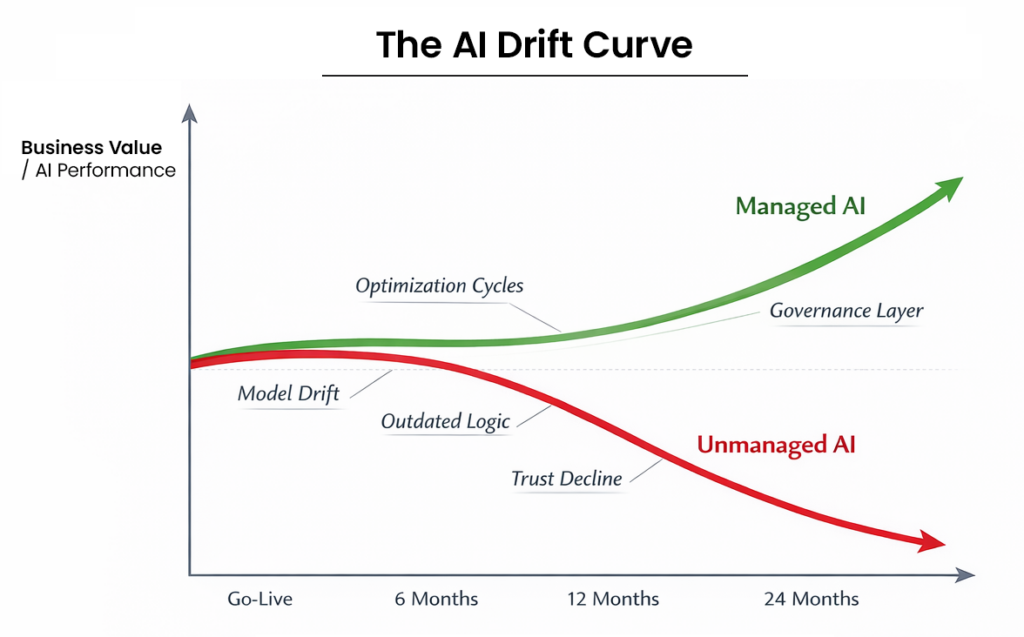
Fast forward six months- and the dashboard no longer reflects how your business actually operates. Your AI agents are working on outdated logic. Recommendations feel misaligned. Your team starts second-guessing the outputs. And that ROI you confidently projected? It still lives in a PowerPoint deck instead of your balance sheet.
If this sounds familiar, you’re not alone. Many enterprises fall into the “set it and forget it” trap, treating AI deployment as a one-time milestone rather than a continuously evolving capability. But AI is not a static tool. Without ongoing monitoring, optimization, retraining, and governance, even the most promising implementation can lose relevance fast. That’s why AI managed services matter far more than the initial go-live; they ensure your intelligence stays intelligent.
Why the ‘Deploy and Walk Away’ Approach Always Fails
AI implementation is not a one-time milestone; it’s an evolving capability that must adapt as your business evolves. If you’re exploring how AI moves beyond recommendations into real-time execution, our blog From Response to Resolution: Transforming Customer Service with Agentic AI expands on this shift When organizations treat AI like a finished project instead of a living system, the risk isn’t immediate; it builds over time. Here’s why:
- Your business doesn’t stand still:
New products launch. Processes change. Markets shift. If AI models aren’t recalibrated to reflect these changes, their recommendations become misaligned with real operations. - Customer behavior evolves:
Buying patterns, service expectations, and engagement channels continuously change. Static models trained on old behavior quickly lose predictive accuracy. - Data drift reduces AI accuracy:
Just as data drift silently degrades model performance over time, the effectiveness of agentic AI depends on clean, connected data that gives it real context, a topic we explore in depth in our blog, How Clean, Connected Data Helps Agentic AI Understand Context. - Regulations and compliance requirements update:
Governance frameworks evolve. AI systems must be reviewed and adjusted to remain compliant and auditable. - Business logic becomes outdated
Rules, workflows, and thresholds configured at launch may no longer reflect current priorities, leading to irrelevant or risky outputs. - Trust erodes quietly
When users see inconsistent or incorrect recommendations, adoption drops. Once trust is lost, recovery is far harder than maintenance. - ROI stalls
AI value compounds only when it’s optimized continuously. Without refinement, performance plateaus, and projected returns remain unrealized.
What Is AI Managed Services and Why Does It Matter?
AI managed services refer to the ongoing support, monitoring, optimization, and governance of AI systems post-deployment. It’s the operational layer that keeps your AI performing as your business evolves, not just on Day 1, but on Day 300, Day 600, and beyond.
This is fundamentally different from a traditional support contract. It’s proactive, not reactive. It’s strategic, not just technical.
A strong AI managed services provider does several things your internal team often can’t sustain alone:
- Monitors model performance and data quality in real time
- Identifies drift before it becomes a business problem
- Iterates on AI agents’ workflow implementation as processes change
- Aligns AI outputs with updated business logic and KPIs
- Manages compliance and governance continuously
- Trains and re-trains models when accuracy degrades
Without this layer, your AI implementation becomes a liability instead of an asset. If this sounds familiar, you may already be seeing early indicators, in fact, many of the same patterns are outlined in our related blog, 10 Signs You Need Salesforce Managed Services to Drive Growth and Efficiency, where we break down the operational signals that it’s time to move from reactive to structured support.
The Real Cost of Unmanaged AI
Let’s be direct. Unmanaged AI costs more than most finance leaders realize as AI predictions become less accurate over time due to shifting data patterns and can quietly reduce decision quality across your operations for months before anyone catches it. By then, the downstream damage is real: poor forecasting, missed service targets, misallocated resources.
There’s also an adoption problem. AI tools that aren’t actively maintained and improve lose user trust fast. Your team stops using them. Your investment flatlines. And then someone starts questioning why you spent the budget in the first place.
The truth is that most failed AI rollouts weren’t failed implementations- they were failed continuations.
The Rise of Agentic AI-and Why It Raises the Stakes
Agentic AI is changing the game entirely. AI agents no longer just analyze it acts. They trigger workflows, update records, send communications, and make decisions across systems. Learn more.
When an AI agent is executing business processes autonomously, the margin for unmonitored drift or misconfiguration shrinks to near zero. A misaligned agent doesn’t just produce a bad report. It takes the wrong action- at scale.
This is why AI agent workflow implementation demands an actively managed layer. You need someone to watch, adjust, and regulate these systems continuously. Not quarterly. Not annually. Continuously.
Graphic Idea: “AI Advisor vs AI Actor”
Visual Concept: Side-by-side comparison
Left Panel:
🧠 Traditional AI
- Recommends
- Flags issues
- Generates reports
Right Panel:
⚙️ Agentic AI
- Triggers workflows
- Reassigns cases
- Escalates issues
- Updates systems
At the bottom:
“Recommendation Risk” vs “Execution Risk”
What Continuous Managed Momentum Actually Looks Like
Managed momentum isn’t just about keeping the lights on. It’s a structured, ongoing commitment to making your AI investment deliver more value over time- not less.
1. AI-Driven Operational Dashboards
Your AI managed services team tracks model outputs, data pipeline health, and system performance. Anomalies are flagged before they become incidents. Dashboards stay current. You stop finding out about problems from end users.
2. Model Tuning and Retraining
As your business data evolves, your models need to follow. AI managed services companies with deep technical capabilities don’t wait for accuracy to crater — they proactively retrain, fine-tune, and recalibrate based on performance thresholds and business signals.
3. Workflow and Integration Updates
Business processes don’t sit still. When a new product line launches, when your CRM structure changes, or when a process gets redesigned, your AI agents need to reflect that reality. Managed services keeps your AI in sync with your operations- not six months behind them.
4. Governance and Compliance
Regulations around data, AI outputs, and automated decision-making are tightening globally. AI cloud managed services teams build compliance checkpoints directly into operational workflows, so you’re not scrambling every time an audit hits.
5. Continuous Stakeholder Alignment
The best AI managed services aren’t just technically sound, they keep business stakeholders informed and aligned. Regular reviews, outcome reporting, and roadmap sessions bridge the gap between your technology and your leadership’s expectations.
If this structure feels like a gap in your current model, our blog 10 Signs Your Enterprise Needs Certinia Managed Services highlights the clear signals that it’s time to move from reactive support to value-driven managed services.
Who Provides Managed Services for AI Workflows?
Not every vendor offering ‘AI support’ is genuinely equipped to deliver managed momentum. The question to ask is: who provides managed services for AI workflows that span complex enterprise systems?
The right partner needs to understand your business processes as deeply as they understand the technology. They need to speak both languages- the language of your operations and the language of your platforms.
Look for AI managed services companies that offer:
- Certified expertise across the AI and platform ecosystem you use
- Structured processes, not ad-hoc firefighting
- Transparent reporting and proactive communication
- A pricing model that doesn’t penalize you for needing ongoing support
- Proven experience with generative AI managed services and agentic workflows
Generative AI managed services require providers who understand how large language models and AI-generated outputs need to be monitored, governed, and aligned with brand and business standards over time. It’s a newer frontier, and not every vendor has caught up.
How AblyPro Delivers AI Managed Services That Keep Pace with Your Business
Organizations move from manual operations to automated workflows, from predictive intelligence to autonomous action. But reaching advanced AI capability is only half the equation. Sustaining and optimizing it is where long-term value is created-or lost.
At AblyPro, we view AI as a maturity journey, not a deployment milestone. We are a Salesforce and Certinia implementation and managed services partner focused on helping enterprises not only deploy intelligent systems but also continuously optimize, govern, and evolve them to deliver sustained business value.
To set the context, our approach falls into one of four broad stages depending on the AI maturity level you are in.
- Manual: Fragmented processes, reactive decisions, limited system trust
- Automated: Workflows and routing structured, but intelligence is still backward-looking
- Intelligent: Predictive alerts and insights available, yet action remains human-led
- Autonomous: AI begins triggering decisions, adjusting workflows, and influencing operations directly
The higher the maturity, the greater the value but also the greater the responsibility. Once AI reaches the autonomous and decision-influencing stage, it stops being a feature and starts becoming infrastructure.
The Critical Layer: AI Managed Services
Once AI begins influencing decisions, triggering workflows, or automating operational actions, it becomes part of your business infrastructure. And infrastructure must be governed, monitored, and continuously improved.
AblyPro’s AI Managed Services focus on four core responsibilities that protect and elevate this maturity:
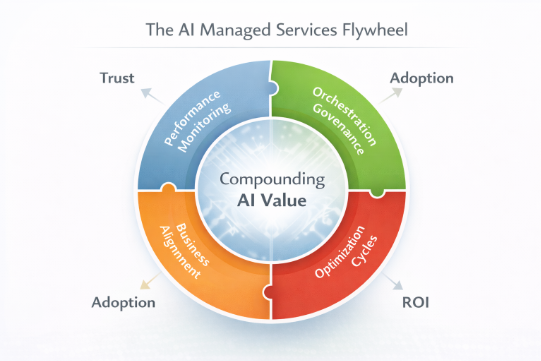
Graphic Idea: “The AI Managed Services Flywheel”
Visual Concept: Circular flywheel with 4 segments:
- Performance Monitoring
- Orchestration Governance
- Business Alignment
- Optimization Cycles
In the center:
“Compounding AI Value”
Outside the flywheel:
- Trust
- Adoption
- ROI
- Risk Control
What This Means for Your Business
AI Managed Services is not an extension of implementation support. It is an ongoing operational stewardship of your AI ecosystem. Once AI begins influencing service delivery, financial forecasting, resource allocation, or customer experience, it becomes part of your operating model. And operating models require ownership.
AblyPro’s AI Managed Services ensures that ownership exists.
Here’s how:
- AI performance compounds instead of plateaus
Models are continuously refined, thresholds recalibrated, and workflows optimized, so performance improves over time rather than stabilizing at “good enough.”
- Automation scales without increasing risk
As AI takes on more responsibility, governance frameworks expand with it. Controls strengthen as autonomy grows.
- Trust remains intact across service, finance, and operations
Users rely on AI outputs because they are monitored, explainable, and aligned with business logic. Adoption remains strong because accuracy remains high.
- ROI becomes measurable and repeatable
Instead of one-time efficiency gains, AI delivers sustained operational improvements, reduced SLA breaches, improved utilization, faster billing cycles, and stronger margin visibility.
At AblyPro, while we structure engagements around an internal maturity lens, what clients experience is straightforward and outcome-driven:
- Clear accountability for AI performance
- Structured governance and risk oversight
- Deep platform expertise across Salesforce and Certinia ecosystems
- Continuous performance improvement built into operations
We do not disengage after deployment. We remain responsible for how your AI systems behave, evolve, and deliver value -long after go-live.
The Bottom Line
The organizations winning with AI right now aren’t the ones who deployed the most sophisticated models. They’re the ones who made a commitment to continuous improvement and found a partner who matched that commitment.
‘Set it and forget it’ works fine for a slow cooker. It’s a recipe for failure when your AI agents are running business-critical workflows.
Managed momentum means your AI gets better as your business grows. It means the ROI you projected in Year 1 is actually realized in Year 2 and Year 3. It means your teams trust the outputs, because a reliable managed services partner is accountable for keeping them trustworthy.
Ready to move from deployment to momentum?
Talk to AblyPro about AI managed services that scale with your ambition at $70/hour, with zero surprises.
Author

AVP, AblyPro

Murali is the AVP – Certinia at AblyPro with 12+ years of experience in handling complex Certinia and Salesforce applications, implementations, configurations, and customizations. At AblyPro, he has been the pillar of all the Certinia PSA and ERP project deliverables, ranging from design to implementation, project management, and resource management. With years of practical knowledge and expertise in this industry, Murali supports the sales team in strategizing customer solutions to meet the actual business needs of the clients. Murali is a dynamic and experienced professional with multiple Certinia and Salesforce certifications, helping businesses to technically strive in this ever-changing landscape.