
First-time fix rate in field service is one of those numbers that quietly decide whether service teams win or bleed money. It affects customer satisfaction, technician productivity, SLA performance, and even renewal revenue. And when it drops, it rarely drops slowly. It collapses. Because repeat visits multiply fast, schedules get clogged, and suddenly every job feels urgent.
Technicians waste nearly a full day each week on paperwork and admin work. That lost time directly impacts job preparation, troubleshooting, and resolution speed. When AI removes those barriers through automation and real-time guidance, service organizations can dramatically improve fix outcomes through connected data, predictive workflows, and agentic execution. Let us find out how AI and Agentforce in field service are becoming the fastest way to improve first-time fix rates.
Why First-Time Fix Rate Matters So Much
The first-time fix rate (FTFR) is a simple metric: How often do you solve the issue in a single visit? Because every time a technician fails to resolve an issue on the first visit, the business pays for it twice, sometimes more. You’re not just adding another truck roll; you’re multiplying costs across operations: extra dispatch planning, additional technician hours, repeated parts handling, and increased administrative workload. This directly controls service profitability, customer satisfaction, and revenue velocity.
A higher fix rate means:
- Fewer truck rolls:
Every avoided second visit saves fuel, labor, and schedule capacity.
- Fewer escalations:
Customers stop calling back angry. Supervisors stop firefighting.
- Faster billing closure:
Work orders get closed quickly, which speeds up invoicing and cash flow.
- Less customer frustration:
Nobody wants “we’ll come back tomorrow” as a service strategy.
This is why first-time fix performance isn’t just a field metric. It’s a profitability metric. Learn how Agentic AI in Field Service powers smarter operations here.
What Breaks First-Time Fix Performance?
Most first-time fix performance issues come from predictable execution gaps. Along with information gathering, like job briefs, customer documentation, permit filings, and other administrative tasks require 30% of an average technician’s working hours, slightly more than the 28% they spend delivering or performing services.
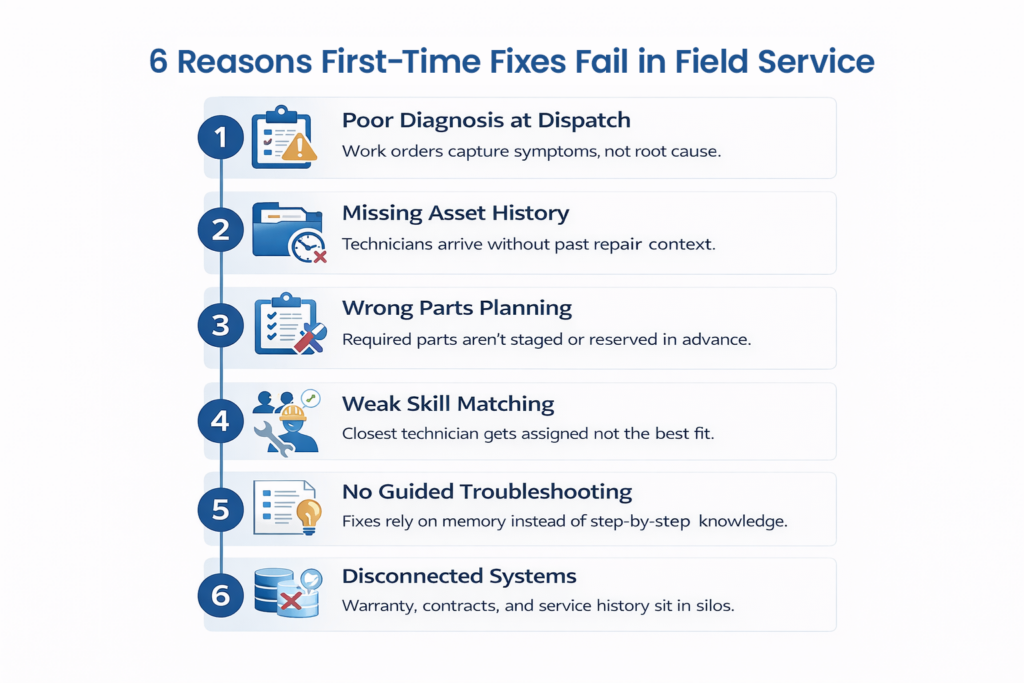
These issues destroy first time fix metrics, even if the technician is excellent. Without the right diagnosis, asset history, parts, and system visibility, even the best tech is forced to guess, delay, or return.
AI-First Field Service: The Shift That Drives Maximum Improvement
Traditional service teams operate in firefighting mode, responding only after an asset fails and then rushing to diagnose, dispatch, and repair under pressure.
But intelligent field service flips the model by using data and AI to predict what’s needed upfront, so technicians arrive prepared with the right context, skills, and parts before the first visit even begins.

What AI Improves Before Dispatch?
1. Better diagnosis
Instead of relying on vague problem descriptions, AI scans similar past cases, failure patterns, and asset behavior to predict the most likely root cause. This reduces guesswork and ensures the work order is built around the real issue, not just the symptoms.
2. Smarter scheduling
AI doesn’t just assign the next available slot; it optimizes timing based on travel distance, technician’s availability, job complexity, expected duration, and even historical delays. This prevents rushed appointments and reduces the chance of incomplete fixes due to time constraints.
3. Improved technician matching
Traditional dispatch often prioritizes proximity. AI prioritizes probability of resolution. It matches the job to the technician with the best combination of skills, certifications, asset familiarity, and past first-time fix performance boosting the likelihood of success on the first visit.
4. Parts prediction
AI predicts which parts are most likely needed based on the asset model, repair history, failure trends, and case type. It can also validate whether parts are in stock, reserved, or need to be staged, preventing the most common reason for repeat visits: missing inventory.
5. Cleaner work order context
Instead of making technicians dig through disconnected notes, AI summarizes key customer details, warranty status, previous repairs, SLA commitments, and known risk factors into a quick, actionable brief. This gives technicians clarity before they arrive onsite.
This is where first-time fix analytics becomes more than just reporting. It becomes a real-time decision engine that actively improves field execution. Instead of analyzing failures after they happen, AI helps prevent them, turning technician’s performance into a scalable advantage across the entire service organization.
Predictive Maintenance Field Service: Fix It Before It Fails
Predictive maintenance field service changes the nature of service calls.
Instead of emergency breakdowns, service becomes a planned intervention. That alone improves success rates.
What predictive maintenance delivers
1. Early failure detection
AI continuously monitors asset performance signals like temperature, vibration, error codes, usage patterns, and service history. Instead of waiting for a breakdown, it flags abnormalities early when the issue is still small and controllable.
2. Proactive work order creation
Once a failure risk is detected, the system can automatically trigger a service request or work order. This shifts service from customer-driven emergencies to planned interventions, reducing downtime and avoiding last-minute dispatch chaos.
3. Reduced part surprises
Because the failure is predicted in advance, teams can identify which parts are likely needed and reserve them before the technician is scheduled. This prevents the most common reason for repeat visits: “the part wasn’t available.”
4. Better technician readiness
Predictive work orders arrive with richer context probable fault type, recommended troubleshooting steps, required tools, and asset history. Technicians walk in prepared instead of diagnosing from scratch onsite.
To understand the bigger picture behind these capabilities, read our blog: What is Field Service Management and How to Get it Right-a practical guide to building a smarter, more scalable service operation.
This directly improves first-time fix rate in field service because predictive maintenance removes uncertainty. When the problem, parts, and repair plan are known upfront, technicians can complete the job in one visit making first-time fix performance more consistent, scalable, and profitable.
Agentforce: Turning AI Insights Into Action
AI can predict. But the prediction doesn’t fix anything by itself.
That’s where Agentforce changes the game.
Agentforce introduces agentic AI into field service operations. It doesn’t just recommend the next steps. It executes workflows and supports technicians’ lives.
How Agentforce improves first-time fix rate
1. Auto-generated pre-work briefs
Agentforce automatically creates a technician-ready summary before the visit, pulling in asset history, recent service activity, warranty details, customer preferences, and safety instructions. This eliminates guesswork and ensures the technician starts the job with full context, not scattered notes.
2. On-site troubleshooting support
During the visit, Agentforce provides real-time guided troubleshooting by recommending the most relevant diagnostic steps based on similar past repairs, error codes, and knowledge articles. This helps technicians move faster, avoid missed steps, and reach the right resolution without relying only on experience or memory.
3. Parts and tool recommendations
Agentforce can predict what parts, tools, and equipment are most likely needed for the job based on the asset type and reported issue. This reduces “return trips” caused by missing inventory and improves technician preparedness before the truck even leaves the depot.
4. Smarter scheduling recovery
When appointments are cancelled, delayed, or rescheduled, Agentforce helps dispatch teams react instantly by triggering reassignment logic, rerouting technicians, and filling schedule gaps with the next best job. This keeps productivity high and prevents wasted technician capacity.
5. Faster job documentation
After the job, Agentforce can auto-summarize service notes, completed actions, parts used, and customer outcomes. This reduces administrative workload, speeds up work order closure, improves data quality, and ensures the next technician has an accurate history, supporting better first-time fix performance long-term.
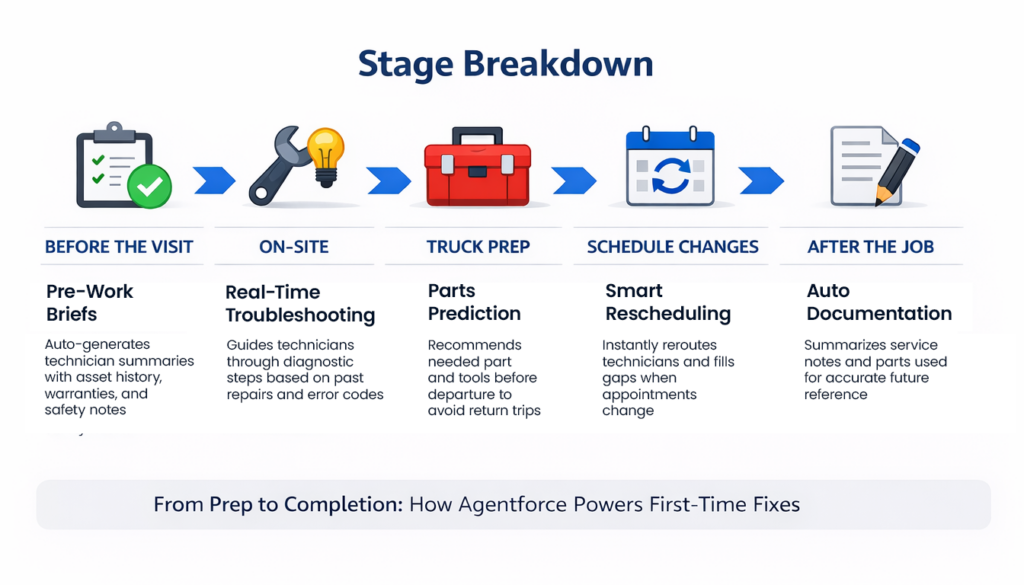
This is how service teams drive major gains in the first-time fix KPI; by reducing admin workload, improving field execution, and closing work orders faster with complete accuracy.
Most teams focus on hitting a first-time fix rate benchmark, but benchmarks alone don’t improve performance. The real value comes from understanding why fixes fail and eliminating those patterns at the source. That’s why elite service organizations track first time fix analytics by root cause, not just overall percentage, because the percentage only shows the symptom, not the operational breakdown.
What high-performing teams measure
1. Repeat visit reason trends
Tracks the most common drivers behind repeat visits (wrong diagnosis, missing parts, incomplete troubleshooting) so teams can fix process gaps.
2. Parts-related fix failures
Measures how often jobs fail due to inventory issues, helping teams improve staging, forecasting, and field stock strategy.
3. Skill mismatch rate
Identifies how often the wrong technician is dispatched, highlighting where skill-based routing needs improvement.
4. Fix rate by asset type
Shows which asset models or equipment categories consistently cause repeat visits, helping prioritize preventive maintenance and knowledge updates.
5. Fix rate by region
Reveals performance variation across territories, uncovering training gaps, dispatch inefficiencies, or inventory limitations by location.
How AblyPro Helps Improve First-Time Fix Rates with AI and Agentforce
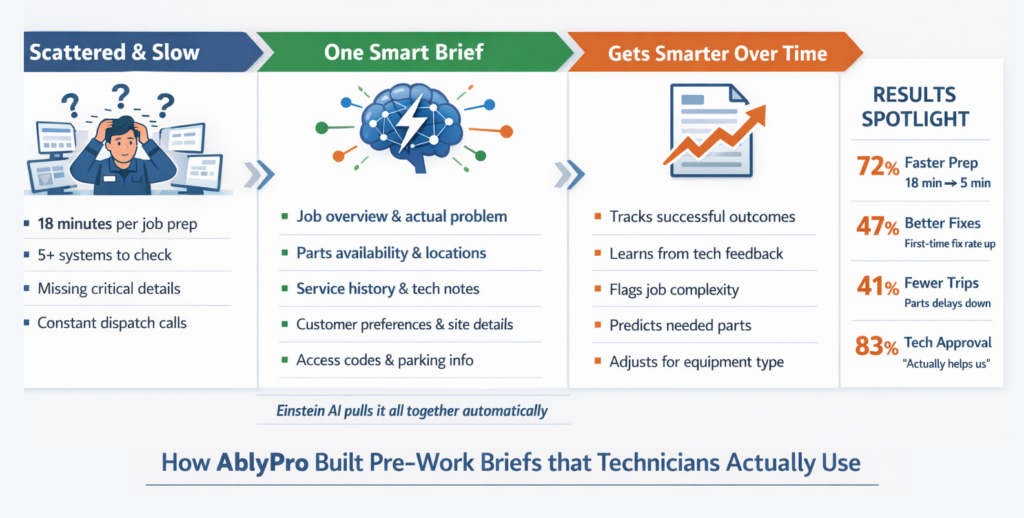
Many organizations invest in AI tools but never see the real impact. The reason is simple. Data and workflows aren’t ready. AblyPro helps service enterprises implement AI and Agentforce in Salesforce Field Service with a direct focus on improving fixed outcomes.
How AblyPro drives first-time fix improvement
- Agentforce implementation in Field Service workflows:
We deploy Agentforce use cases like job summarization, scheduling actions, and technician guidance.
- Data readiness for intelligent field service:
We structure asset, work order, and case data so AI recommendations are accurate.
- Predictive maintenance enablement:
We help build workflows that connect asset signals to proactive service action.
- Parts and inventory integration:
We connect inventory systems so technicians aren’t forced into repeat visits.
- First time fix analytics dashboards:
We create dashboards that track first time fix metrics by cause, region, and asset type.
- Continuous optimization:
We refine dispatch rules, AI prompts, and workflows to keep performance improving.
The Final Takeaway
Technicians aren’t the bottleneck; service readiness is. First-time fix failures rarely happen because the technician lacks skill. They happen because the technician arrives without the right diagnosis, parts, context, or next-best action.
That’s where AI in Field Service changes the game. AI strengthens preparation through smarter diagnosis, optimized scheduling, and parts prediction. Agentforce takes it further by automating execution, guiding technicians in real time, and reducing the manual coordination that slows down every service organization.
If you want to improve first time fix rate, don’t just measure the KPI, rebuild the workflow that drives it. Create an AI-first service operating model where first-time fix performance becomes predictable, scalable, and repeatable.
Ready to make first-time fix your competitive advantage? Learn how AI and Agentforce can transform your field service performance.
Author

Content Coordinator

Surbhi Bhatia is a Content Coordinator at AblyPro, specializing in creating strategic, insight-driven content around Salesforce, Certinia, and AI-led enterprise solutions. With a strong focus on simplifying complex technology narratives, she works closely with subject matter experts to translate business and technical concepts into compelling, audience-first storytelling.
At AblyPro, Surbhi plays a key role in shaping thought leadership assets, campaign messaging, and digital content that supports go-to-market initiatives and drives brand visibility. Her work spans across e-books, landing pages, webinars, and social campaigns; ensuring consistency, clarity, and impact at every touchpoint.
With a keen eye for detail and a deep understanding of content strategy, she contributes to building AblyPro’s voice as a trusted partner for organizations navigating digital transformation.