Service teams today are under pressure to do more with less. Customers expect fast, personalized, and consistent support. Leaders expect efficiency, scale, and measurable outcomes. Data is everywhere, yet decisions still get delayed, escalations still happen too late, and agents still spend time on work that adds little value.
This is where AI changes the equation. But not all AI plays the same role. Einstein AI and Agentic AI work best together; one focuses on intelligence and insight, the other on execution and action. In this blog, we’ll break down how they complement each other, real agentic AI use cases in service, and why this combination is becoming essential for modern customer service teams.
Table of Contents
ToggleUnderstanding the Two Roles: Einstein AI vs. Agentic AI
Before diving into use cases, it’s important to understand what each AI brings to the table.
Einstein AI: Turning Service Data into Clear Insight
Einstein AI is Salesforce’s intelligence layer that sits on top of Service Cloud and continuously learns from your service data. It looks at both historical patterns and what’s happening right now across cases, customer interactions, agent activity, and outcomes.
Instead of forcing leaders to dig through dashboards, Einstein AI highlights what matters most. It predicts trends like rising case volumes, flags customers at risk of escalation or churn, and recommends next-best actions for agents during live cases.
For service teams, this means fewer surprises. Leaders gain visibility into potential issues before they impact SLAs, and agents get guidance that helps them resolve cases faster and more consistently. Einstein AI answers the question: What’s happening, and what should we pay attention to next?
Agentic AI: Turning Insight into Action
Agentic AI builds those insights and takes responsibility for execution. Rather than waiting for a human to interpret a recommendation, Agentic AI acts automatically based on predefined goals, rules, and real-time context.
It can trigger workflows, escalate cases, reroute work, notify the right teams, or initiate proactive outreach without manual intervention. These actions happen continuously in the background, even when teams are busy or offline.
This is where service operations start to feel self-driving. Routine decisions are handled automatically; response times shrink, and teams stay focused on complex, high-value interactions. Agentic AI answers the question: What needs to happen next, and how do we make it happen now?
How Einstein AI Enables Smarter Decisions
Einstein AI plays the role of the “brain” in service operations. It continuously processes large volumes of historical service data, cases, interactions, trends, and behaviors that humans can’t realistically analyze at scale. By connecting these signals in real time, it helps teams spot patterns early, predict what’s coming next, and make smarter decisions before issues escalate. Read more.

Einstein AI makes service data understandable and actionable. But insight alone doesn’t close tickets or prevent escalations.
Real Einstein AI Use Cases in Customer Service
Einstein AI strengthens service teams by bringing intelligence directly into everyday decisions. It doesn’t replace agents or automate execution. Instead, it analyzes data at scale and surfaces timely, contextual insights that help agents act faster and more accurately.
Here’s how Einstein AI delivers value in real customer service environments:
1. Faster Resolutions with Einstein Article Recommendations
Einstein AI analyzes case context, customer history, and issue patterns to recommend the most relevant knowledge articles in real time.
This helps agents by:
- Reducing time spent searching for answers
- Ensuring consistent, approved responses
- Improving accuracy across complex or repeat issues
The result: quicker resolutions and higher first-contact success without increasing agent effort.
2. Intelligent Case Routing
Einstein AI evaluates incoming cases based on urgency, issue type, customer profile, and historical resolution data.
It supports service teams by:
- Recommending the most appropriate queue or agent
- Reducing manual triage and reassignment
- Improving workload balance across teams
Cases reach the the right hands sooner, minimizing delays and unnecessary transfers.
3. Personalized Guidance with Einstein Next Best Action
Einstein AI identifies the most relevant next steps for agents based on customer behavior, case history, and business rules.
This enables agents to:
- Take consistent, context-aware actions
- Prioritize the right response at the right moment
- Align service interactions with broader business goals
Service becomes more proactive and personalized, without relying on guesswork.
4. Improved Agent Efficiency with Einstein Case Summaries
Einstein AI automatically generates concise summaries of long or complex cases, highlighting key details and recent activity.
This allows agents to:
- Get up to speed quickly during handoffs or escalations
- Reduce time spent reviewing case histories
- Focus more on resolution and customer interaction
The result is smoother collaboration and faster response times, especially in high-volume environments.
Where Agentic AI Changes the Game
Agentic AI works autonomously by turning intelligence into action. Instead of waiting for humans to interpret insights and take action, Agentic AI works continuously in the background. It monitors signals in real time, triggers the right workflows, coordinates actions across systems, and keeps service operations moving without delays or manual handoffs.
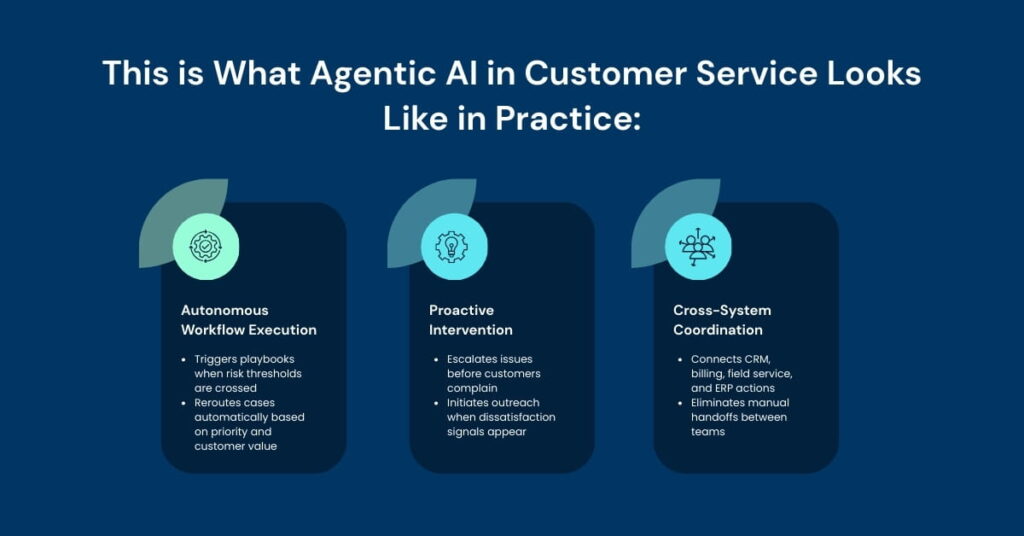
This is why agentic AI platforms are becoming core to agentic AI in business, especially in service-heavy enterprises.
Real Agentic AI Use Cases in Service
When Einstein AI and Agentic AI work together, service teams stop reacting to problems after customers feel the impact. Instead, service operations run with built-in anticipation and execution. Einstein AI identifies what’s likely to happen, while Agentic AI makes sure the right action happens immediately.
Here’s how that plays out in real service environments:
- Preventing SLA Breaches
Einstein AI continuouslymonitors case volume, backlog, complexity, and historical resolution patterns to predict when SLAs are at risk.
Agentic AI responds instantly by:
- Rebalancing workloads across queues
- Reassigning high-risk cases to available or specialized agents
- Alerting managers before deadlines are missed
The result: SLAs are protected before customers notice delays.
- Proactive Customer Retention
Einstein AI flags customers showing early signs of dissatisfaction based on sentiment, repeat cases, and escalation patterns.
Agentic AI then:
- Launches proactive outreach workflows
- Assigns senior agents or success managers
- Schedules follow-ups automatically
This shifts retention from damage control to early intervention.
- Faster First-Contact Resolution
Einstein AI supports agents with real-time recommendations, similar case resolutions, and relevant knowledge.
Agentic AI takes it further by:
- Executing approved resolutions
- Logging updates automatically
- Closing follow-up tasks without manual effort
Agents resolve more cases on the first interaction, with less friction. To see how this plays out in practice, explore our blog 5 Practical Agentic AI Use Cases Driving Productivity Across Salesforce and Certinia
- Smarter Case Routing
Einstein AI evaluates urgency, customer value, and issue complexity.
Agentic AI acts autonomously by:
- Routing the case to the best-fit agent or team
- Avoiding unnecessary hop offs or queue hopping
- Adjusting routing dynamically as conditions change
Together, these agentic AI use cases streamline service operations, reduce delays, and let teams focus on meaningful customer engagement instead of system management.

Together, they form a scalable enterprise agentic platform that supports both intelligence and automation.
Why This Combination Matters for Service Leaders
Service leaders aren’t struggling because they lack dashboards. They’re struggling because every decision still requires manual interpretation, coordination, and follow-up. That creates delay, fatigue, and inconsistency, especially at scale.
When Einstein AI and Agentic AI work together, service operations shift from “analyze, then act” to “understand and act in real time.”
This combination allows leaders to:
- Receive insights early, before issues escalate
- Turn recommendations into action without waiting on manual steps
- Reduce operational drag caused by handoffs, approvals, and follow-ups
- Free agents from administrative work so they can focus on customers
- Deliver consistent service experiences, even as volumes grow
The result is a service organization that moves faster, responds smarter, and scales without burning out teams. This is what a practical, modern agentic AI strategy looks like in action; not more tools, but better outcomes with less friction.
The Role of Data in an Agentic AI Strategy
None of this works without the right data foundation.
Agentic AI relies on accurate, connected signals to decide and act. If customer records are duplicated, service histories are fragmented, or workflows don’t reflect real operations, automation becomes unreliable very quickly.
For agentic AI platforms to perform well, organizations need:
- Standardized customer and case data across systems
- Service processes that reflect how teams actually work
- Governance that keeps data accurate as volumes and use cases grow
This is where having the right guide matters. AblyPro acts as an AI GPS for service teams, helping navigate the AI journey with clarity and control. With deep expertise across Salesforce and Certinia environments, they help organizations prepare data through cleansing, migration, standardization, and integration with other business applications.
By aligning data, processes, and platforms upfront, service leaders give Agentic AI the foundation it needs to operate with confidence, turning automation from a risk into a reliable advantage.
Final Takeaway
Einstein AI gives service teams clarity by continuously analyzing data, spotting patterns, and predicting what’s coming next. Leaders move from hindsight to foresight, with early visibility into risks, priorities, and opportunities.
Agentic AI turns those insights into action. Autonomous agents operate in real time, rerouting cases, triggering workflows, and resolving routine tasks, so decisions don’t stall waiting for manual intervention.
Together, they transform customer service from reactive support to proactive, intelligent execution. Leaders plan with confidence. Agents focus on meaningful work. Customers get faster, more consistent resolutions.
The real shift isn’t about adding more tools. It’s about building the right AI strategy and data foundation, one where intelligence and automation work together seamlessly, at scale.
Ready to explore how Einstein AI and Agentic AI can work together in your service organization? Schedule a free assessment with experts
Author

AVP, AblyPro

Murali is the AVP – Certinia at AblyPro with 12+ years of experience in handling complex Certinia and Salesforce applications, implementations, configurations, and customizations. At AblyPro, he has been the pillar of all the Certinia PSA and ERP project deliverables, ranging from design to implementation, project management, and resource management. With years of practical knowledge and expertise in this industry, Murali supports the sales team in strategizing customer solutions to meet the actual business needs of the clients. Murali is a dynamic and experienced professional with multiple Certinia and Salesforce certifications, helping businesses to technically strive in this ever-changing landscape.