Agentic AI changes how work moves through an organization.
Instead of waiting for updates, approvals, or manual intervention, Agentic AI continuously observes what’s happening across Salesforce and Certinia, understands context, and initiates the right next steps. It connects signals from service, field operations, projects, and finance to keep work flowing without unnecessary delays.
This shift has a direct impact on productivity. Bottlenecks are identified earlier, handoffs happen faster, and teams spend less time coordinating work and more time executing it.
In this blog, we explore five practical, real-world ways Agentic AI boosts productivity and reduces operational bottlenecks, using examples from Salesforce Service Cloud, Field Service, and Certinia.
Table of Contents
Toggle5 Real-World Use Cases Where Agentic AI Removes Bottlenecks and Boosts Productivity
Agentic AI delivers productivity gains not by speeding people up, but by removing the friction that slows work down. The following use cases show how this plays out across Salesforce and Certinia environments.
1. Preventing Escalations Before Service Teams Feel the Pressure
Use Case: Salesforce Service Cloud
The Challenge
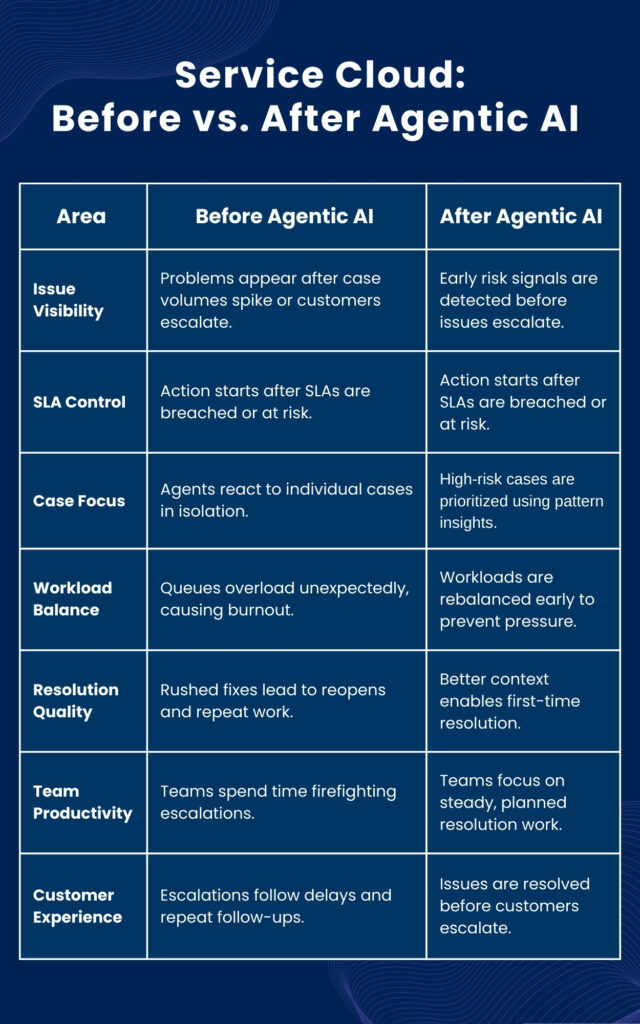
In traditional service operations, teams react after problems are already visible:
- Case volumes spike unexpectedly
- SLAs are breached before action is taken
- Customers escalate issues after repeated follow-ups
By the time managers step in, agents are overwhelmed, and case resolution quality suffers.
How Agentic AI Helps
Agentic AI continuously monitors multiple service signals together:
- Case inflow trends, not just daily totals
- Response times, reopen rates, and sentiment shifts
- Early indicators that point to escalation forming
Instead of reacting to individual cases, Agentic AI identifies patterns that suggest pressure is building.
What changes in practice:
- High-risk cases are surfaced early, before queues overflow
- Supervisors receive proactive alerts instead of SLA breach notifications
- Workloads are rebalanced before agent fatigue sets in
Outcome
- Fewer escalations and SLA violations
Issues are identified and addressed early, before they grow into urgent problems or breach response commitments.
- Better first-time resolution quality
Agents have the right context upfront, helping them resolve issues correctly the first time instead of reopening cases.
- Service teams stay productive instead of firefighting
Teams focus on steady, planned work rather than reacting to last-minute escalations and overload.
2. Keeping Field Teams Moving Without Midday Disruptions
Use Case: Salesforce Field Service
The Challenge
Field schedules often look efficient at the start of the day,but break down quickly:
- One delayed job triggers missed appointments downstream
- Dispatchers scramble to reshuffle schedules manually
- Technicians lose productive time waiting or rerouting
Most adjustments happen too late to prevent disruption.
How Agentic AI Helps
Agentic AI observes field operations in real time by connecting:
- Job progress and completion patterns
- Travel time deviations and technician availability
- Historical delay trends across similar jobs
When a delay starts forming, Agentic AI intervenes early.
Outcome
- Less idle time for technicians:
Work is routed proactively, so technicians spend more time on jobs and less time waiting or backtracking.
- Fewer reschedules and missed appointments:
Delays are addressed early, keeping schedules stable and customers informed.
- More jobs completed per day with the same workforce:
Smarter planning and early adjustments help teams complete more work without adding headcount.
Agentic AI removes the productivity bottleneck created by late reactions.
3. Catching Project Risk Before Timelines and Margins Slip
Use Case: Certinia PS Cloud
The Challenge
Project risk rarely appears overnight. It builds quietly through:
- Small delivery delays
- Rising utilization without visibility
- Scope changes that slowly erode margins
By the time issues are flagged, corrective options are limited.
How Agentic AI Helps
Agentic AI monitors project signals together, not in isolation:
- Timeline progress and milestone health
- Effort burn versus planned utilization
- Staffing patterns and early margin drift
It identifies risk while it’s still manageable.
What changes in practice:
- Project managers are alerted before milestones slip
- Resource adjustments happen earlier and with context
- Margin erosion is detected while corrective action is still possible
Outcome
- Fewer late-stage project recoveries:
Risks are identified early, so teams adjust plans before projects slip into emergency mode.
- More predictable delivery outcomes:
Timelines, effort, and margins stay aligned because issues are addressed while they’re still manageable.
- PMs spend time guiding projects, not fixing surprises:
Project managers focus on planning and stakeholder alignment instead of last-minute firefighting.
4. Removing Finance Bottlenecks Before Month-End Chaos
Use Case: Certinia FM Cloud
The Challenge
Finance teams often uncover issues late in the cycle:
- Missing or incorrect time entries
- Billing delays tied to project data gaps
- Revenue recognition mismatches discovered during close
This leads to rushed fixes, delayed invoices, and stressful month-end cycles.
How Agentic AI Helps
Agentic AI connects operational and financial data in real time:
- Project activity and time tracking
- Billing milestones and revenue rules
- Variances between operational reality and financial records
Instead of surfacing problems at close, it flags them as they form.
What changes in practice:
- Missing entries are identified early and corrected quickly
- Billing delays are resolved before invoices stall
- Revenue risks are visible well before close
Outcome
- Faster, smoother month-end close:
Issues are identified and resolved early, so close cycles run with fewer last-minute fixes.
- Fewer billing surprises:
Gaps and inconsistencies are caught before invoices are generated, reducing rework.
- Finance teams focus on analysis, not data chasing:
Clean, connected data lets teams spend time on insights and decisions instead of tracking missing information.
5. Coordinating Action Across Teams Instead of Creating Silos
Use Case: Certinia CS Cloud (Cross-Cloud Context)
The Challenge
Productivity loss often comes from disconnected teams:
- Service teams don’t see project impact
- Project teams lack visibility into customer risk
- Finance reacts after issues cascade downstream
Each team works hard—but without shared context.
How Agentic AI Helps
Agentic AI operates across systems, not within silos:
- It understands how service issues affect customer health
- It links project delays to retention and revenue risk
- It aligns signals across Service, Projects, and Finance
What changes in practice:
- Teams act with shared, consistent context
- Decisions happen faster because data aligns
- Fewer handoffs, clarifications, and delays

Outcome
- Work flows across teams instead of stopping at system boundaries:
Shared data allows service, project, and finance teams to act in sync without handoffs slowing progress.
- Better coordination without more meetings:
Teams operate from the same signals and context, reducing the need for constant alignment calls.
- Productivity improves across the entire lifecycle:
Fewer delays and clearer ownership keep work moving smoothly from service through delivery and billing.
A Practical Reminder: Productivity Depends on Data Clarity
Agentic AI depends on trust in the data it observes. When customer records conflict, project details are outdated, or financial data doesn’t match operational reality, the AI slows down or hesitates. It can’t confidently decide what matters or what action to take next.
Clear, connected data removes that friction. When Salesforce and Certinia systems agree on customers, projects, service activity, and financial signals, Agentic AI can recognize patterns early, prioritize correctly, and act without second-guessing. That’s when productivity gains become consistent, not occasional.
Preparing data isn’t just a technical step. It’s what allows Agentic AI to move from reactive assistance to proactive action across service, field operations, projects, and finance.
If you’re exploring Agentic AI and want to understand how data readiness impacts real outcomes, connect with AblyPro experts to learn what a strong foundation looks like in practice.
Final Takeaway
Agentic AI improves productivity by acting earlier, before delays turn into escalations, bottlenecks spread across teams, or month-end pressure builds. As this blog showed, its impact spans Service Cloud, Field Service, and Certinia environments by spotting patterns, coordinating actions, and keeping work moving smoothly across systems.
The real productivity gains don’t come from pushing teams to work faster. They come from removing the friction created by late signals, disconnected data, and reactive processes. When Agentic AI has a clear context, teams spend less time catching up and more time delivering outcomes.
Schedule a 1:1 consultation to learn more.
Author

AVP, AblyPro

Murali is the AVP – Certinia at AblyPro with 12+ years of experience in handling complex Certinia and Salesforce applications, implementations, configurations, and customizations. At AblyPro, he has been the pillar of all the Certinia PSA and ERP project deliverables, ranging from design to implementation, project management, and resource management. With years of practical knowledge and expertise in this industry, Murali supports the sales team in strategizing customer solutions to meet the actual business needs of the clients. Murali is a dynamic and experienced professional with multiple Certinia and Salesforce certifications, helping businesses to technically strive in this ever-changing landscape.