Service organizations sit on piles of data. Cases, tickets, interactions, entitlements, all that information is hiding clues about risk, bottlenecks, and opportunities. Yet most teams stay stuck. They look at dashboards that explain what happened yesterday. They react to problems only after customers complain.
High-performing service teams treat data, analytics, and automation as parts of a single customer service workflow, not disconnected tools. When service leaders link data to insights and insights to action, reactivity gives way to anticipation and measurable results. In this blog, we break down how data becomes insight, how insight drives decisions, and how decisions trigger action inside daily service operations.
The 3-Step Framework to Smarter Service Operations
Step 1: Data- Turning Service Noise into a Reliable Signal
Good reporting begins with trustworthy data. Without it, service teams operate on assumptions, dashboards lose credibility, AI insights feel unreliable, and decision-making slows down.
Service organizations generate enormous volumes of data every day. Cases, tickets, interactions, response times, entitlements, customer history, and usage signals are constantly created throughout the customer service workflow process. But volume does not equal value. When data is inconsistent or fragmented, it becomes noise instead of a signal.
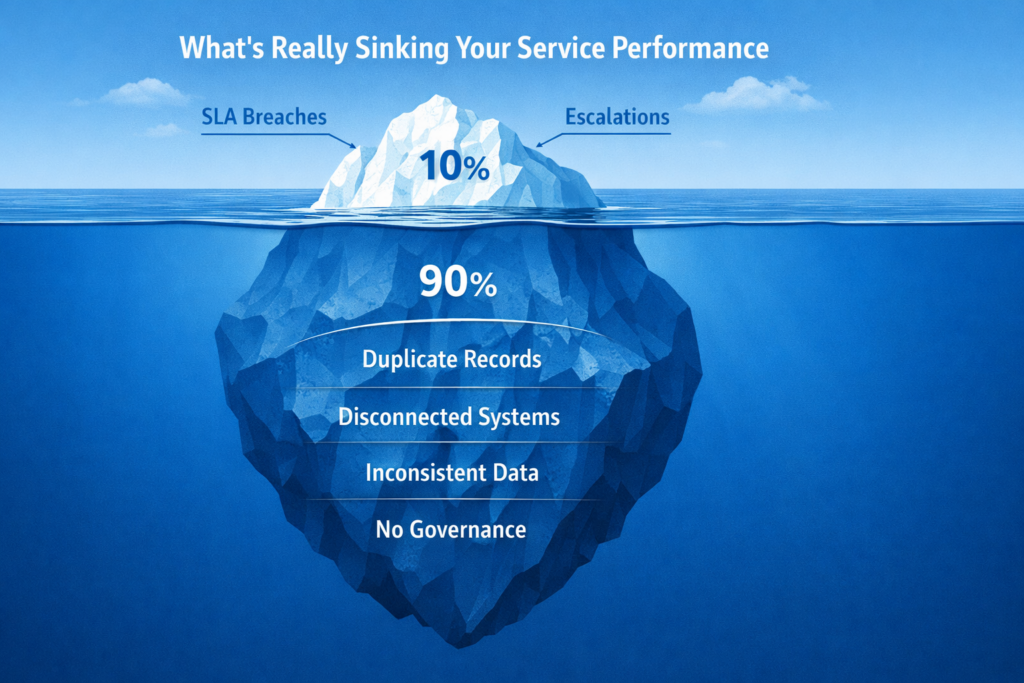
What usually goes wrong
- Inconsistent case categorization:
Similar issues are logged under different categories. Over time, reporting loses accuracy. Patterns disappear, making root-cause analysis nearly impossible.
- Unclear SLA definitions and ownership:
SLAs exist, but they are not clearly defined or owned. Teams disagree on what counts as a breach, and alerts arrive too late to matter.
- Duplicate or incomplete customer records:
Fragmented profiles break service history. Trends become distorted. Insights based on customer behavior lose reliability.
- Data spread across disconnected tools and objects:
Critical service data lives in multiple places. Teams rely on manual work to assemble a complete picture, introducing delays and errors. This fragmentation is exactly why establishing a single source of truth becomes critical for faster, smarter decision-making, as explored in our blog Build a Smarter Business with a Single Source of Truth
What high-performing service teams do
High-performing teams don’t chase more data. They shape the data that powers their customer service workflow management.
- Standardize case lifecycles and resolution states:
Every case follows a clear, shared path. Status changes mean the same thing to everyone, enabling consistent reporting and automation.
- Align SLA, entitlement, and priority logic with real service behavior:
Rules reflect how work gets done. Alerts become meaningful instead of noise.
- Create a unified view of service data:
Customer, case, entitlement, and activity data connect cleanly. Teams see the full context without stitching information together manually.
- Apply ongoing data governance:
Quality checks, ownership models, and validation rules keep data accurate as volume and complexity grow. This discipline is essential for enabling agentic workflows, as explored in Building the Foundation of Agentic AI with Data Governance
When data delivers a reliable signal, teams stop debating numbers and start acting on them. Trust becomes the foundation for every decision that follows.
Step 2: Insights- From Visibility to Operational Intelligence
Clean data alone does not change outcomes. Insight does.
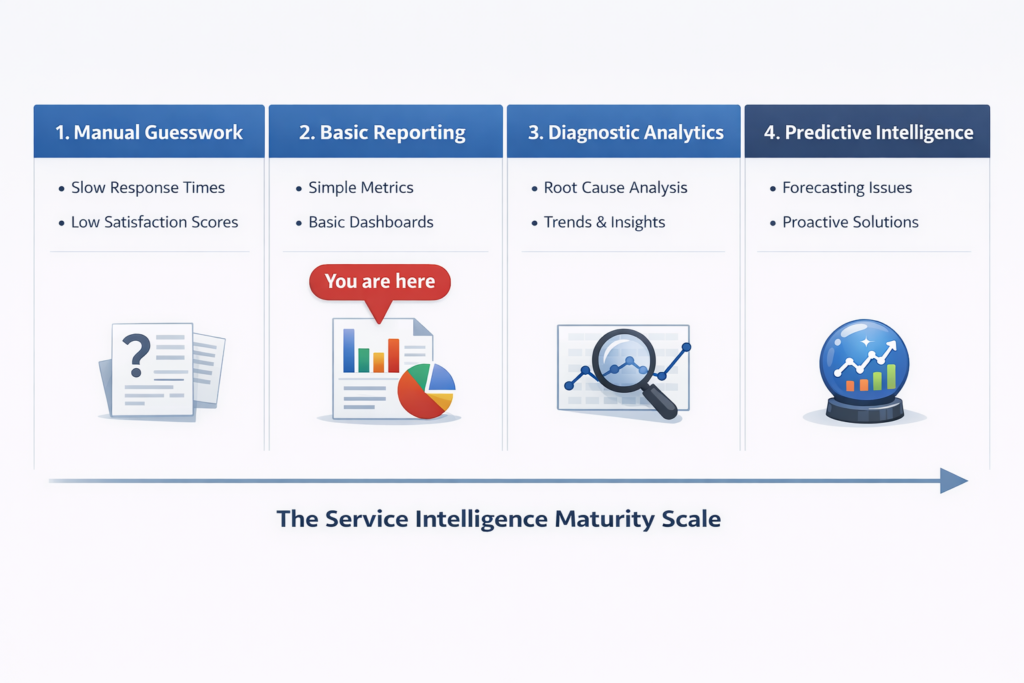
Most service teams stop at visibility. They know what happened. They know how many cases arrived. They know average resolution times. That information explains the past but offers little protection for the future.
High-performing teams use insights to anticipate risk and guide action across their customer service workflow stages.
What basic reporting tells you
- Case volume trends
- Resolution times
- Backlog size
This is useful for awareness but limited for decision-making.
What operational intelligence reveals
- Which cases are most likely to breach SLAs
- Which customers show early signs of dissatisfaction or churn
- Where backlog and capacity strain will appear next
- Which issues carry the highest business impact
These insights help teams prioritize work based on risk and outcome, not urgency alone. Learn how the rise of AI in customer service aids in smart support here.
How insights should show up in daily operations
- Predictive prioritization
Cases are ranked by likelihood and impact, helping agents focus on what truly matters. This approach reflects how predictive intelligence helps service teams anticipate customer needs and deliver seamless support, a concept explored further in AI in Customer Service: Ways to Enhance Customer Experience.
- Early warning signals
Potential issues surface before they escalate into customer complaints or escalations.
- Context-rich recommendations
Insights explain why something matters, not just that it does.
- Embedded visibility
Intelligence appears inside daily workflows, not in separate reports that require extra effort to check.
The purpose of insight is clarity that should answer one simple question: What should we do next?
Step 3: Action- Making Insight Operational
Insight without action creates awareness, not improvement.
Many organizations invest heavily in analytics but stop short of execution. Teams see risks forming but still rely on manual judgment, delayed responses, and inconsistent follow-through.
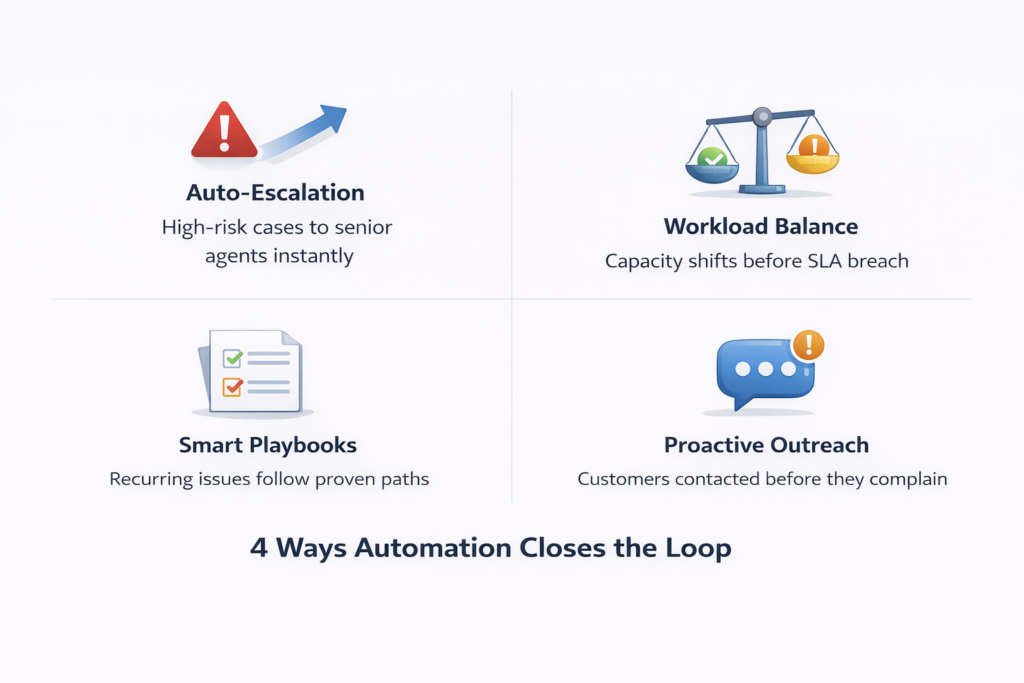
High-performing service teams close the loop by applying best practices for automating customer service workflows.
What action looks like in practice
- Automatic escalation of high-risk cases:
When risk crosses a threshold, the system responds immediately, not hours later.
- Workload rebalancing triggered by SLA risk:
Capacity adjusts before performance degrades.
- Predefined playbooks for recurring issues:
Known problems follow proven response paths instead of ad-hoc handling.
- Proactive customer communication:
Customers are informed before frustration builds, strengthening trust.
Automation and intelligent agents are not about removing people from the process. They remove delay, inconsistency, and guesswork so humans can focus on problem-solving. This shift toward systems that act with context and intent is the foundation of Agentic AI, which is explained in detail in Agentic AI Explained: A Beginner’s Guide for Modern Enterprise
What makes action effective
- Clear ownership for every triggered response
- Guardrails to prevent over-automation
- Measurable outcomes tied to each action
- Continuous refinement based on results
When action is designed intentionally, insights stop being suggestions, and start driving outcomes.
How AblyPro Helps Service Teams Operationalize the Data-Insights-Action Workflow
Building a connected Data-Insights-Action workflow is not a one-time effort. It requires platform expertise, operational alignment, and ongoing ownership.
This is where AblyPro makes the difference.
As a Salesforce and Certinia implementation and managed services partner, AblyPro helps service organizations replace fragmented tools with a unified, outcome-driven service system using modern AI platforms for customer service workflows.
Building the right foundation
AblyPro starts with how service teams actually operate.
- Aligns configurations with real case lifecycles, SLAs, and entitlements
- Cleans, unifies, and governs service data
- Establishes data trust so analytics and AI deliver credible signals
This foundation turns service data into a reliable operational input.
Designing insights that drive decisions
AblyPro focuses on insights that guide action, not observation.
- Analytics built around risk, priority, and impact
- Intelligence embedded directly into agent and leadership workflows
- AI recommendations aligned to service goals
The result is clarity at the moment decisions are made.
Making action part of the service model
Execution is designed in, not added later.
- Automation that responds to insight in real time
- Governed workflows that balance speed and control
- Agentic capabilities that reduce delay without removing human oversight
Every insight leads to a defined, measurable response.
Sustaining performance through managed services
Service systems change over time. AblyPro ensures performance does not slip across customer service workflows through:
- Continuous process and automation optimization
- Ongoing data governance and quality monitoring
- Regular refinement of analytics and AI behavior
- Proactive platform health and support
This keeps the Data-Insights-Action workflow effective long after go-live.
Wrapping Up
Service teams don’t struggle because they lack tools. They struggle because data, insight, and action exist in silos, forcing teams to react after impact instead of preventing it.
This blog outlined a complete Data-Insights-Action workflow that changes that dynamic. Reliable data creates confidence. Operational insights focus attention on what matters most. Intentional action turns intelligence into consistent, measurable outcomes. When these elements work together, service becomes anticipatory rather than reactive.
That shift doesn’t happen by accident. It requires design, discipline, and the right partner.
If your organization is ready to move beyond static dashboards, disconnected automation, and constant firefighting, AblyPro can help you build a service system that thinks, decides, and acts as one.
To turn insights into action, talk to our experts.
Author

AVP, AblyPro

Murali is the AVP – Certinia at AblyPro with 12+ years of experience in handling complex Certinia and Salesforce applications, implementations, configurations, and customizations. At AblyPro, he has been the pillar of all the Certinia PSA and ERP project deliverables, ranging from design to implementation, project management, and resource management. With years of practical knowledge and expertise in this industry, Murali supports the sales team in strategizing customer solutions to meet the actual business needs of the clients. Murali is a dynamic and experienced professional with multiple Certinia and Salesforce certifications, helping businesses to technically strive in this ever-changing landscape.