Customer service teams are under constant pressure to do more with less. Rising ticket volumes, higher customer expectations, and complex service environments make it difficult to decide where to focus on time and effort. Not every issue deserves the same level of attention, but without the right intelligence, teams often treat them that way.
This is where AI in customer service, combined with advanced analytics, plays a critical role. Together, AI and analytics help organizations identify, prioritize, and act on high-impact customer service use cases, those that directly affect customer satisfaction, retention, revenue, and operational efficiency.
This blog explores how AI and analytics work together, the benefits of AI in customer service, real-world examples, the role of generative AI in customer service, and the challenges of integrating AI in customer service system
Why Prioritization Is the Real Customer Service Problem
That clarity comes from knowing what to prioritize, what to fix, and what actually moves service outcomes. Our eBook- The 2025 Service Leader’s Blueprint for Building a Predictable, Profitable Service Model shows how to cut through noise, align data to decisions, and build a service model that scales with confidence.
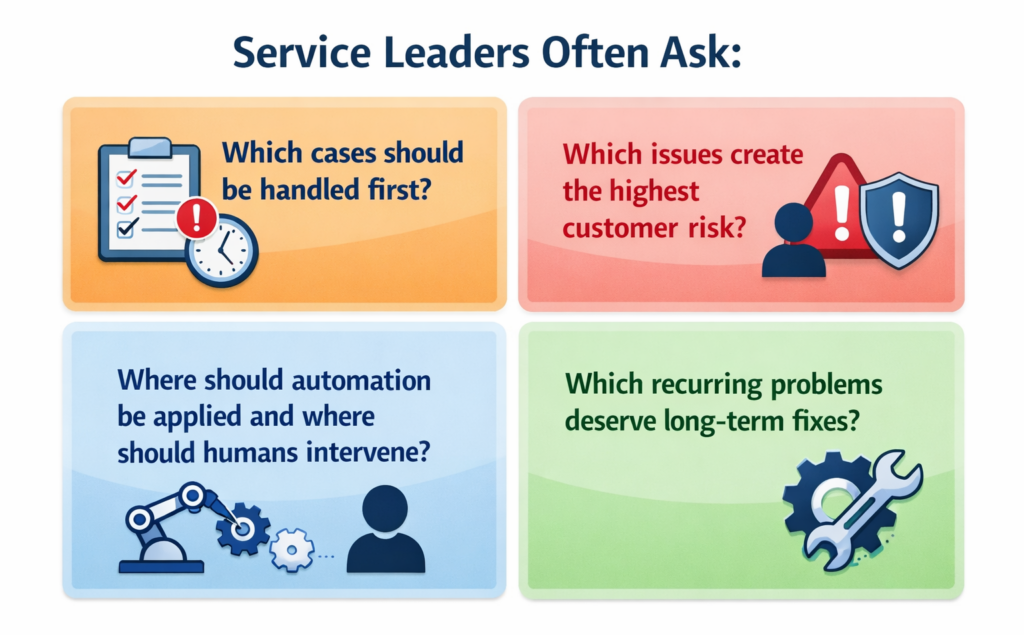
Without analytics, prioritization relies on static rules, manual judgment, or gut instinct. Without AI, analytics remain retrospective rather than actionable. When combined, AI and analytics shift customer service from reactive firefighting to proactive impact management.
The Role of Analytics in Customer Service Prioritization
Analytics provide the foundation for intelligent decision-making by turning raw service data into usable insight. Each capability plays a distinct role in understanding performance and pressure points.
- Case volume trends by product, channel, or customer segment:
This reveals where demand is coming from and how it changes over time. Teams can see which products generate the most issues, which channels create the highest load, and which customer segments need the most support. This helps with capacity planning, training focus, and proactive fixes.
- Resolution time and SLA performance:
These metrics show how efficiently issues are handled and where delays occur. By analyzing resolution times across case types and teams, leaders can identify bottlenecks, process gaps, or skill shortages that directly impact customer experience and contract compliance.
- Escalation frequency and root cause analysis:
Escalation data highlights where frontline teams struggle to resolve issues independently. Root cause analysis goes deeper, uncovering whether escalations stem from product defects, unclear processes, missing knowledge articles, or policy constraints.
- Customer sentiment and satisfaction patterns:
Sentiment analysis and CSAT trends connect operational performance to customer perception. This helps teams understand how resolution speed, communication quality, and outcomes influence loyalty and repeat interactions.
- Agent productivity and workload distribution:
These insights show how work is spread across agents and how effectively time is used. Leaders can spot overworked teams, underutilized capacity, and skill mismatches that affect both performance and agent burnout.
Together, these analytics uncover patterns and explain what is happening and why. But they remain retrospective. They inform strategy and improvement efforts, yet they don’t dynamically prioritize actions as conditions change. That is where AI steps in.
How AI and Analytics Work Together
AI uses analytics-driven insights to make real-time decisions at scale. Instead of static dashboards, AI operationalizes analytics inside daily workflows. High-quality, well-managed data is the fuel that makes AI and analytics reliable, accurate, and truly actionable. Eighty-seven percent of analytics and IT leaders say advances in AI make data management a high priority.
Here’s how AI in customer service builds on analytics:
- Analytics identifies patterns in historical data:
Analytics reveals recurring trends in case volume, resolution time, sentiment, and escalations, creating a clear baseline of what drives service demand and performance.
- AI models learn which patterns lead to churn, escalation, or dissatisfaction:
AI analyzes these trends to identify the specific signals that predict negative outcomes, such as repeated contacts, missed SLAs, or declining sentiment.
- New cases are automatically scored, categorized, and prioritized:
Incoming cases are evaluated in real time, assigned risk and priority levels, and routed so high-impact issues receive immediate attention.
- Agents receive contextual recommendations for action:
AI surfaces relevant knowledge, suggested responses, and next-best actions directly within the agent workflow, reducing effort and improving consistency.
This combination ensures high-impact use cases don’t get buried under routine requests.
How AI Can Be Used in Customer Service to Prioritize Use Cases
There are several practical ways AI and analytics come together to drive prioritization:
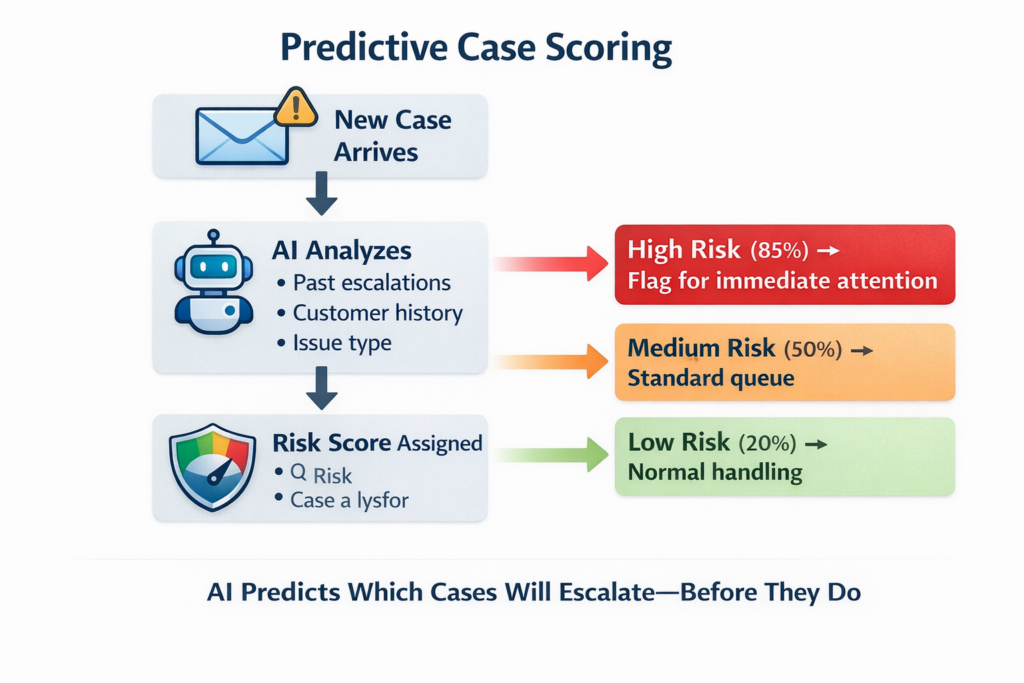
1. Predictive Case Scoring
AI models analyze historical outcomes, such as escalations, churn, or CSAT drops-and assign risk scores to new cases. Cases likely to create negative outcomes are automatically flagged as high priority.
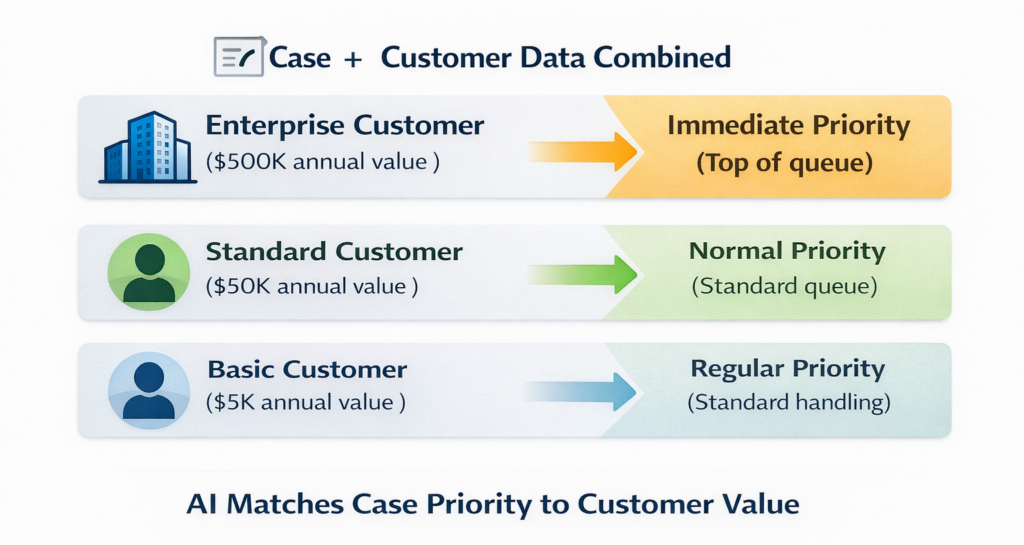
2. Customer Value-Based Prioritization
By combining customer analytics (revenue, contract value, lifetime value) with AI predictions, service teams can prioritize issues that impact high-value or strategic customers.
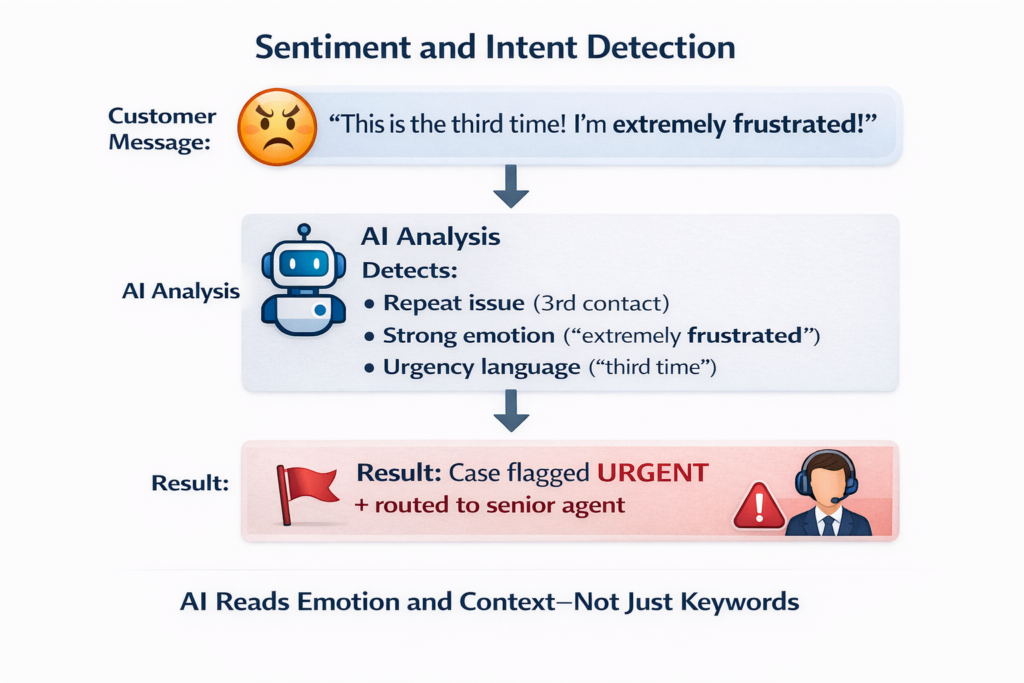
3. Sentiment and Intent Detection
Using NLP, AI evaluates customer language to detect frustration, urgency, or dissatisfaction. When combined with sentiment analytics, emotionally charged cases receive faster attention.
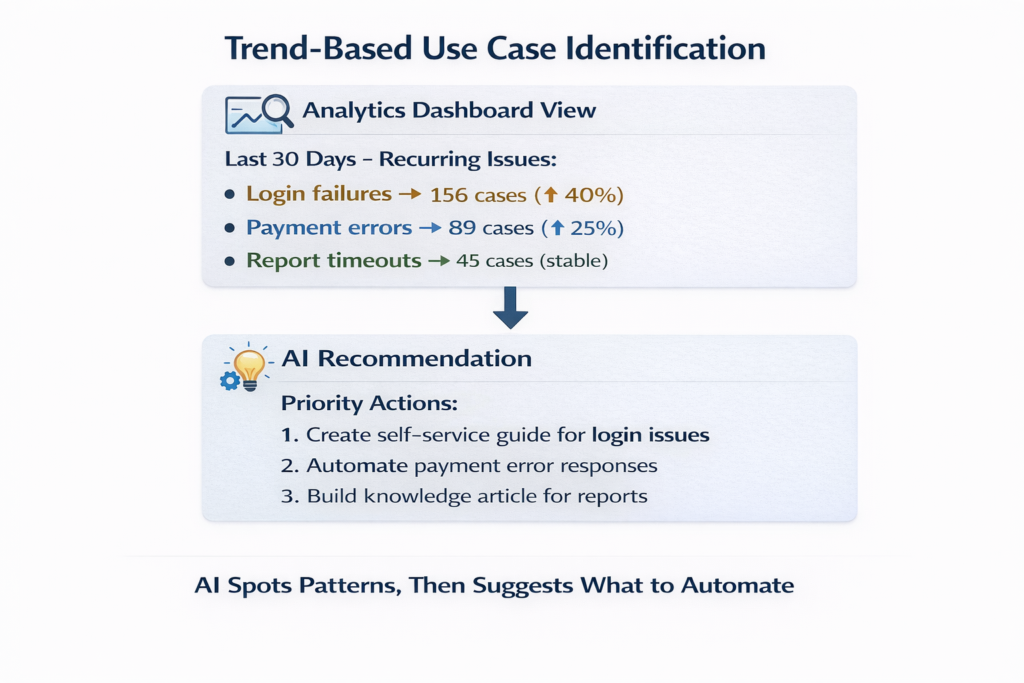
4. Trend-Based Use Case Identification
Analytics reveals recurring issues across products or regions. AI uses these trends to recommend high-impact use cases for automation, knowledge base updates, or proactive outreach.
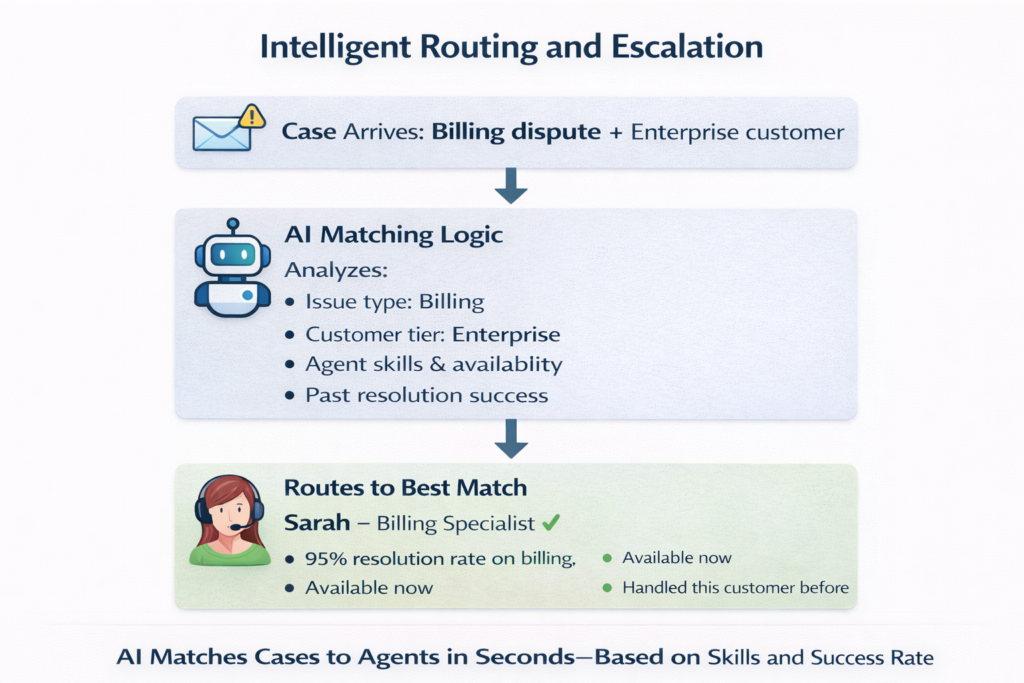
5. Intelligent Routing and Escalation
AI in customer service automation routes cases to the right agent or team based on skills, past performance, and likelihood of fast resolution, reducing delays and rework.
To see how these prioritization strategies fit into the broader evolution of modern support, explore our earlier blog, The Rise of AI in Customer Service: Smart Support Starts Here, which explains how AI first transforms service foundations before optimizing use-case prioritization at scale.
Benefits of AI and Analytics in Customer Service
AI in customer service works best when paired with strong analytics. Together, they help organizations move beyond volume-based decisions and focus on the service interactions that truly affect customer outcomes and business performance.
- Faster Identification of High-Impact Issues:
Analytics surfaces historical patterns tied to escalations, SLA breaches, and dissatisfaction. AI in customer service automation uses these insights to flag and prioritize high-risk cases in real time, reducing delays and manual triage. - Better Customer Experiences Through Intelligent Prioritization:
By evaluating urgency, sentiment, and predicted outcomes, AI ensures that complex or emotionally charged cases receive immediate attention. This is one of the most tangible benefits of AI in customer service; customers feel acknowledged and supported when it matters most. - Smarter Use of Agent Capacity: AI automatically distinguishes between cases that require human expertise and those suitable for automation. This allows agents to focus on meaningful work while routine requests are handled efficiently, improving productivity without sacrificing service quality.
- Scalable Decision-Making Across Growing Case Volumes:
As service demand increases, AI applies consistent prioritization logic across channels and regions. Analytics provides the strategic context, while AI operationalizes it at scale, something static dashboards alone cannot achieve. - Data-Driven Service Strategy and Continuous Improvement:
Analytics-backed insights help leaders identify where automation, training, or process improvements will deliver the highest return. Over time, AI learns from outcomes and continuously refines how customer service use cases are selected and prioritized.
Examples of How AI and Analytics Drive Service Impact
AI and analytics enable service teams to prioritize use cases based on impact, risk, and urgency rather than static rules or volume alone.
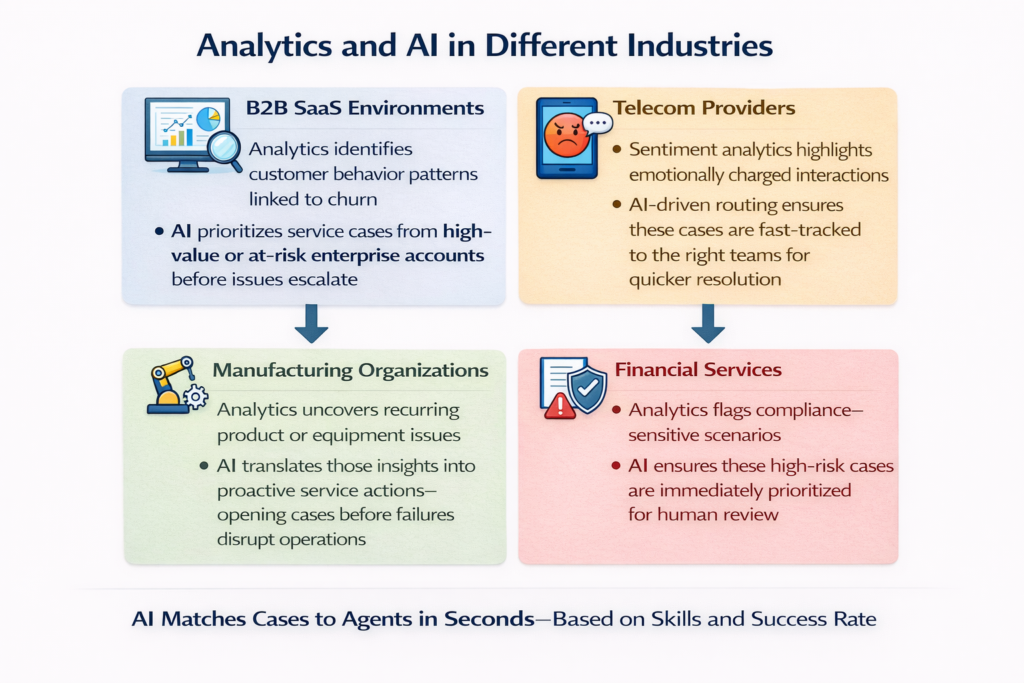
Together, these examples demonstrate how AI and analytics shift customer service use case prioritization from predefined rules to continuous, intelligence-driven decision-making focused on real business and customer impact.
AI in Customer Service Automation vs. Human Judgment
One common misconception is that AI should automate everything. The reality is that most successful models combine automation with human oversight.
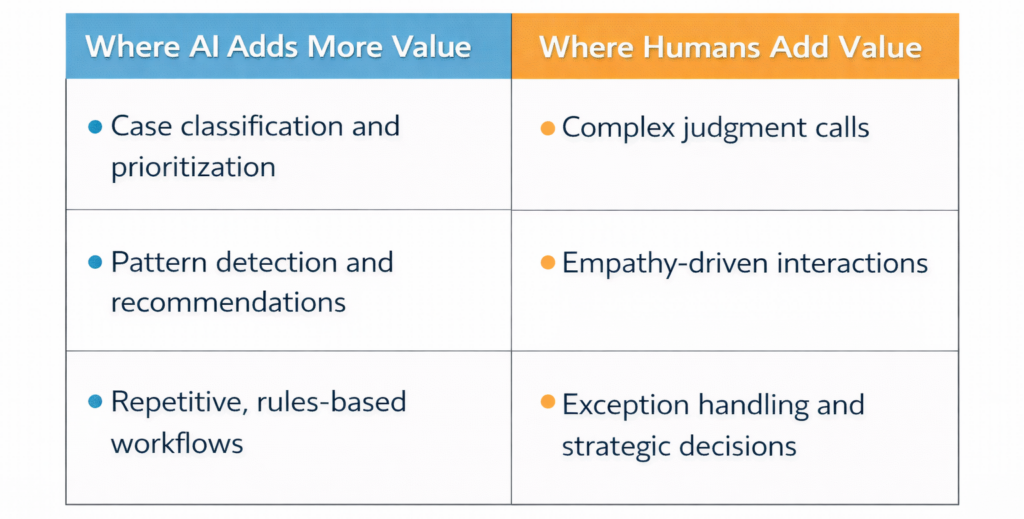
Analytics helps define where automation delivers value, and where human expertise matters most.
Challenges of Integrating AI in Customer Service Systems
Despite the momentum around AI in customer service, adoption is rarely straightforward. Most challenges don’t stem from the technology itself, but from how organizations prepare for and integrate it into day-to-day service operations.
1. Data Fragmentation
Customer context is often scattered across CRM platforms, ticketing tools, billing systems, and third-party applications. When AI models operate on partial data, they miss patterns, misread intent, or surface insights without enough context to act on. Fragmentation limits AI’s ability to see the full customer journey, especially critical in enterprise service environments. This is why a single source of truth is essential, something we explore in our blog, Build a Smarter Business with a Single Source of Truth.
2. Poor Data Quality
AI systems amplify the quality of the data they are trained on. Incomplete records, inconsistent categorization, outdated fields, or manual workarounds introduce noise that reduces prediction accuracy. When agents encounter recommendations that feel unreliable, trust erodes quickly, slowing adoption and diminishing value. Learn more.
3. Workflow Misalignment
AI insights often live in dashboards or side panels that sit outside the agent’s primary workflow. If agents must switch screens, interpret abstract scores, or manually translate insights into actions, usage drops. For AI to be effective, recommendations must appear at the right moment, in the right context, and directly support decisions agents already make.
4. Change Management and Trust
AI changes how agents work, how performance is measured, and how decisions are prioritized. Without a clear explanation of why a recommendation is made and how it should be used, AI can feel opaque or threatening. Training, transparency, and gradual rollout are essential to building confidence rather than resistance.
5. Over-Automation Risk
One of the most common missteps is automating too early or too broadly. Without analytics to identify which scenarios truly benefit from automation, organizations risk scaling low-impact or high-risk use cases. This can lead to poor customer experiences, compliance issues, or unnecessary operational complexity.
6. Lack of Use-Case Prioritization
Many AI initiatives begin with tools instead of outcomes. Teams experiment with chatbots, case classification, or sentiment scoring without a clear understanding of which use cases move key service metrics. The result is scattered pilots that generate activity, but not a measurable impact.
Addressing these challenges requires more than adding AI capabilities; it requires direction and guidance. AblyPro acts as AI GPS helping service organizations slow down before scaling: clarifying where analytics should lead, where AI should follow, and how each step connects to real service outcomes. The emphasis stays on navigation, not acceleration.
Successful AI adoption begins with the right question:
Which customer service use cases create the highest business impact?
Analytics helps uncover those opportunities. AI helps operationalize them at scale. Together, when applied deliberately, they ensure customer service technology drives meaningful results, not automation for its own sake.
Final Thoughts
Using AI and analytics to prioritize high-impact use cases in customer service is not about replacing human agents, it’s about enabling smarter decisions, faster responses, and better outcomes.
By combining analytics-driven insights with AI-powered prioritization, organizations can focus on what truly matters: resolving the right problems, for the right customers, at the right time.
For service leaders looking to move beyond reactive support, this approach isn’t optional, it’s foundational. Curious how AI and analytics can work together in your customer service environment? Let’s explore what’s possible.
Author

AVP, AblyPro

Murali is the AVP – Certinia at AblyPro with 12+ years of experience in handling complex Certinia and Salesforce applications, implementations, configurations, and customizations. At AblyPro, he has been the pillar of all the Certinia PSA and ERP project deliverables, ranging from design to implementation, project management, and resource management. With years of practical knowledge and expertise in this industry, Murali supports the sales team in strategizing customer solutions to meet the actual business needs of the clients. Murali is a dynamic and experienced professional with multiple Certinia and Salesforce certifications, helping businesses to technically strive in this ever-changing landscape.