Customer service has hit a wall. Teams are buried under repetitive tickets; agents struggle with fragmented systems, and leaders lack visibility into what’s driving performance. Traditional chatbots handle basic FAQs, but they can’t make decisions, prioritize actions, or adapt to complex scenarios. They’re reactive tools in an industry that demands proactive intelligence.
AI-powered workforce intelligence changes this completely. Unlike passive chatbots that wait for commands, Agentforce acts autonomously, analyzing situations, making decisions, and executing tasks without human intervention. It doesn’t just answer questions; it routes cases, recommends parts, schedules technicians, and escalates issues based on real-time context. For service operations drowning in complexity, this shift from reactive automation to intelligent agency is transformative. Let’s explore this in-depth, in the blog.
What Makes Agentforce for Workforce Different?
Chatbots follow scripts. Agentforce for Service Workforce Management autonomously manages tasks and workflows to keep service operations running efficiently.
Here’s the distinction:
- Chatbots respond to what customers ask
- Agentforce understands the context and takes action
Want the bigger picture on Agentic AI? Explore our blog.
A chatbot tells a customer their order status. Agentforce sees a delayed shipment, predicts the customer will complain, proactively sends a discount code, and alerts the warehouse, before the customer even reaches out.
This autonomous decision-making capability is why Agentforce AI for workforce productivity is gaining momentum. Learn more in our blog,Empowering Service Teams with Agentic AI | Boost Productivity & CX. It doesn’t require constant supervision. It learns patterns, adapts to exceptions, and improves over time.
How Agentforce AI Workforce Automation Transforms Service Operations
1. Workforce Automation That Actually Thinks
Agentforce for workforce goes beyond robotic process automation (RPA). RPA mimics human clicks. Intelligent AI understands context.
Consider field service scheduling. Traditional automation assigns the nearest available technician. Agentforce considers:
- Technician skill match
- Parts inventory on their truck
- Traffic patterns
- Customer priority tier
- Historical first-time fix rates
It schedules smarter appointments, reducing repeat visits by 30-40%. That’s not automation; that’s intelligence.

But the impact goes deeper. Agentforce workforce optimization analyzes technician performance patterns across thousands of service calls. It identifies which technicians excel at specific equipment types, which struggle with repair scenarios, and where coaching opportunities exist. This intelligence feeds back into scheduling decisions, creating a continuous improvement loop.
When a complex repair ticket comes in, the AI doesn’t just check for availability. It evaluates which technician has the highest success rate for that specific issue, whether they have the required parts, and if their current route allows for efficient service delivery. The result? First-time fix rates climb from 60% to 85%, customer satisfaction improves, and technicians spend less time on repeat visits.
2. Real-Time Decision Support for Service Teams
Agentforce for service workforce management acts as a continuous advisor embedded directly into agent workflows. The moment an agent opens a case, the AI engine activates.
It analyzes:
- Case description and urgency indicators
- Customer history and sentiment from previous interactions
- Product information and known issues
- Knowledge base articles with proven resolution paths
- Similar cases resolved by top performers
Within seconds, the AI-powered workforce intelligence surfaces:
- Relevant troubleshooting steps ranked by success probability
- Next best actions based on customer context and business rules
- Escalation triggers if case complexity exceeds agent skill level
- Pre-drafted responses that agents can customize and send
This is intelligent guidance that adapts in real time as the conversation evolves. If the customer mentions a new symptom, the AI recalibrates its recommendations instantly. If standard troubleshooting fails, it automatically suggests escalation paths and identifies the right specialist.
Agents stop wasting 10 minutes searching for knowledge bases or asking supervisors for guidance. Decision time drops to under 2 minutes. More importantly, resolution quality becomes consistent. New hires perform like veterans because they have the same intelligence guiding their actions. The performance gap between agents shrinks dramatically.
3. Predictive Action Instead of Reactive Response
Service leaders traditionally manage by looking backward, reviewing last month’s metrics to address this month’s problems. Agentic AI for service leaders flips this model entirely.
It continuously monitors operational data, identifying patterns invisible to human analysis like:
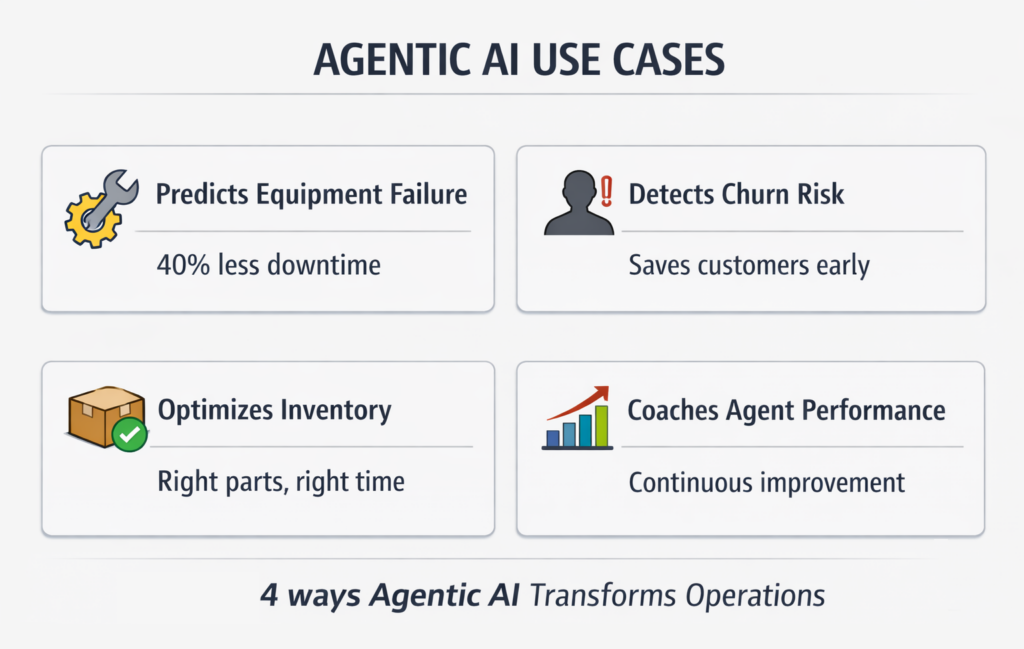
Equipment Failure Prediction
By analyzing sensor data, maintenance history, and usage patterns, Agentforce identifies assets likely to fail within 30 days. It automatically generates preventive maintenance work orders, schedules the right technicians, and orders replacement parts, before the breakdown occurs. Unplanned downtime drops by 40%.
Customer Churn Risk Detection and Response
AI workforce automation for service teams tracks sentiment across support interactions, response times, product usage decline, and billing disputes. When risk scores cross thresholds, it triggers retention workflows: priority routing, proactive outreach, loyalty offers. You save customers before they leave.
Inventory Optimization
Traditional reordering relies on historical averages. Agentforce for workforce forecasts demand based on seasonal patterns, equipment age distributions, failure trend analysis, and regional service activity. It predicts which parts will be needed where and when, reducing stockouts while cutting excess inventory.
Agent Performance Coaching
Agentforce AI identifies human agents struggling with specific case types or showing declining productivity metrics. It flags these patterns for managers and recommends targeted training interventions. Performance management shifts from quarterly reviews to continuous, data-driven coaching.
AI-powered workforce intelligence ensures that your service operation stop reacting and starts anticipating. Problems get solved before they impact customers. Resources get allocated where they’ll have maximum impact. Strategy becomes proactive instead of defensive.
The Foundation: Clean Data Powers Intelligent Agents
Here’s the hard truth: Agentforce AI workforce automation learns from your data. If the data is flawed, the outcomes are too, only faster and at scale. Most service organizations operate with compromised data quality. Years of manual entry, system migrations, and siloed platforms create a mess. Here are some inconsistencies that directly impact how Agentforce interprets customer context.
Duplicate Customer Records
The same customer exists three times in your CRM,once as “ABC Corporation,” once as “ABC Corp,” and once as “ABC Company.” When the AI tries to analyze customer history or route cases, it fragments the context. Support quality suffers because agents can’t see the complete relationship.
Inconsistent Part Naming Conventions
One technician logs a part as “PWR-SPLY-500W.” Another uses “Power Supply 500 Watt.” A third enters “PS500.” Your AI can’t recognize these as the same component. Part recommendations become unreliable. Inventory forecasting breaks down. Technicians order wrong items.
Incomplete Case Histories
Critical fields sit empty because agents rush through documentation. Equipment serial numbers missing. Root cause analysis skipped. Resolution notes vague or absent. The AI tries to learn patterns from incomplete information and develops flawed decision models.
Siloed Data Across Systems
Customer data lives in the CRM. Inventory data sits in the ERP. Service history exists in a legacy field service platform. Knowledge articles scattered across multiple repositories. The AI can’t build contextual intelligence when information stays trapped in disconnected systems.
What Agentforce AI for Workforce Productivity Requires
Clean, standardized data isn’t optional for Agentforce implementation. It’s the foundation everything else depends on. Learn how clean, connected data enables agentic AI to understand context and make smarter decisions. Read the blog.
Deduplication
Every customer, asset, and part needs exactly one authoritative record. Merge duplicates systematically. Establish matching rules that catch variations in naming, spelling, and formatting. One customer, one record, one source of truth.
Standardization
Implement controlled vocabularies for critical fields. Part numbers follow consistent formats. Equipment types use standardized taxonomies. Case categories align with defined structures. When data follows predictable patterns, AI can learn reliable correlations.
Completeness
Mandate required fields for critical workflows. Equipment serial numbers must be captured. Case closure requires resolution documentation. Customer interactions need sentiment coding. Missing data creates blind spots that compromise AI decision quality.
Data Governance
Assign ownership for data quality maintenance. Establish validation rules that prevent bad data entry at the source. Implement regular audits to catch degradation. Data quality isn’t a one-time cleanup—it’s an ongoing discipline.
Integration
Break down system silos. Connect your CRM, ERP, field service platform, and knowledge base. Build unified data flows so the AI can access the complete context. Discover how a single source of truth leads to faster, smarter business decisions. A customer’s purchase history, support interactions, equipment installed, and parts consumed should be instantly available in a single view.
Organizations that skip the data groundwork face a predictable outcome: AI projects deliver impressive proof-of-concept demos but fail in production. Agentforce makes baffling decisions because it’s learning from corrupted patterns. Trust erodes. Adoption stalls. The initiative gets labeled as “AI hype that didn’t work.”
Organizations that invest in clean, structured data see the opposite-Agentforce understands context, makes reliable decisions, and automates work with confidence. Trust grows, teams adopt the system faster and AI becomes a capability that consistently delivers real operational value.
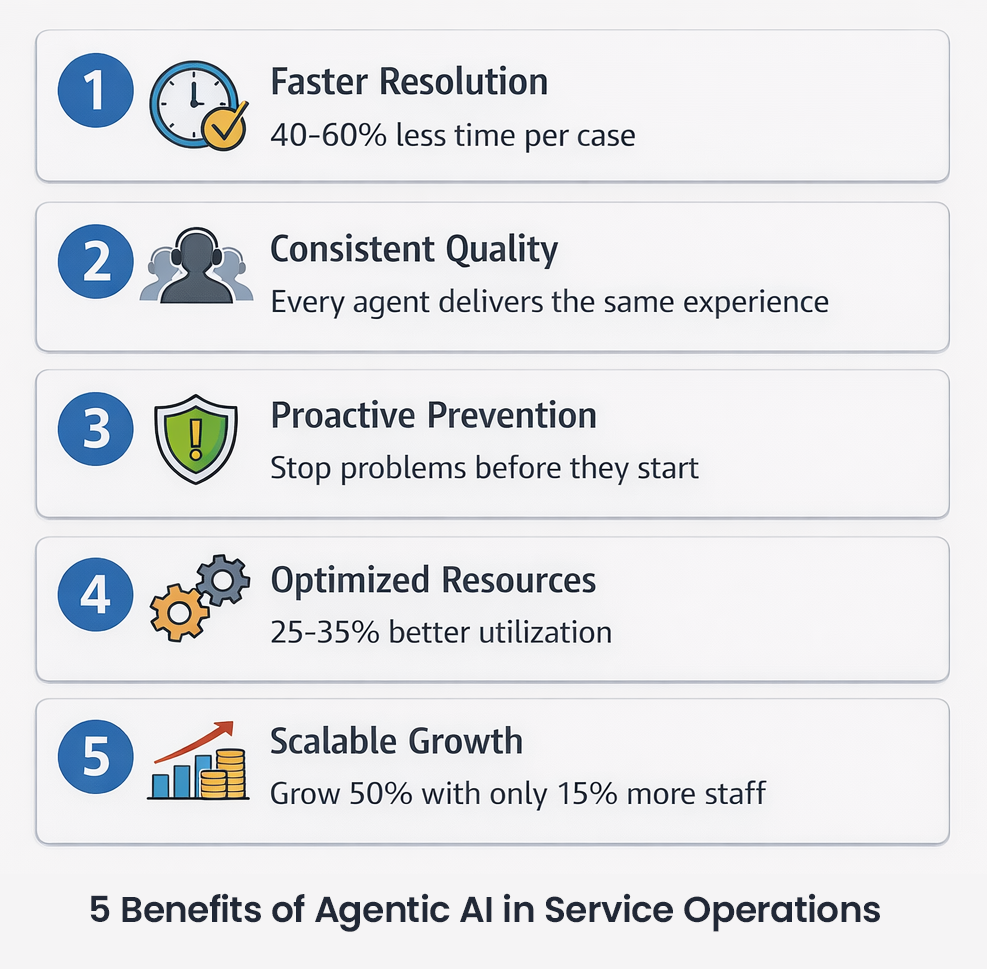
5 Benefits of Agentforce for Service Workforce Management
1. Dramatic Reduction in Resolution Time
Agentforce for workforce eliminates the delays that plague traditional support workflows. Agents don’t hunt for information, supervisors don’t field constant questions, and customers don’t wait in queue while complexity gets assessed.
Intelligent AI instantly categorizes cases, surfaces relevant solutions, and recommends the next action. What took 20 minutes now takes 4 minutes. Average handle time drops 40-60%. Your team handles twice the volume without additional headcounts.
2. Consistent Quality Across All Interactions
Service quality traditionally varies wildly based on agent experience. While veteran support specialists deliver excellent resolutions, new hires struggle. This results in customers getting inconsistent experiences. Agentforce AI workforce automation levels this playing field. Every agent gets the same intelligent guidance drawn from your top performers’ best practices. The AI doesn’t get tired, frustrated, or forgetful. It delivers consistent recommendations on case 1 and case 1,000.
Customer satisfaction becomes predictable instead of random.
3. Proactive Issue Prevention
Traditional service models are inherently reactive. Equipment breaks, then you fix it. Customers complain, then you respond. Problems escalate, then you intervene.
AI-powered workforce intelligence applications shifts this paradigm. The AI predicts failures before they occur, identifies at-risk customers before they churn, and flags inventory shortages before stockouts happen.
You move from firefighting to fire prevention. Customer experience improves because problems get solved before they cause frustration.
4. Optimized Resource Allocation
Service leaders constantly struggle with resource planning. Where should you deploy technicians? Which agents need coaching? What inventory levels make sense for each location?
Agentforce for service workforce management answers these questions with data-driven precision. It analyzes demand patterns, skill requirements, and capacity constraints to recommend optimal resource allocation.
Technician utilization increases 25-35% because routing and scheduling become intelligent. Training budgets focus on actual skill gaps instead of generic programs. Inventory turnover improves because forecasting aligns with real demand signals.
5. Scalability Without Proportional Cost Increases
Growing service operations traditionally means hiring proportionally. Double your customer base, double your support team. Expand to new regions, replicate entire service infrastructures.
Agentforce AI for workforce productivity transformation breaks this linear scaling model. The AI handles routine decisions and repetitive tasks that would otherwise require human effort. As volume grows, the AI simply processes more cases without needing “more AI.”
You can expand service capacity by 50% while increasing headcount by only 15%. Margins improve as AI handles the volume surge without proportional cost growth.
AblyPro: Your AI GPS for Service Transformation
AI systems like Agentforce do not operate effectively on fragmented data or unstable processes. That is why our approach combines data readiness with a structured AI maturity framework that helps service organizations progress toward autonomous operations.
AblyPro acts as your AI GPS,helping you map the journey, avoid costly mistakes, and reach your destination faster.
We Prepare Your Data for AI Success
Before deploying any AI agent, we conduct comprehensive data readiness work:
Audit Your Data Landscape
We analyze your current data quality across all service systems. Where are the duplicates? What fields sit empty? Which naming conventions conflict? Where do system silos break context? You get a clear picture of what needs fixing.
Cleanse and Standardize
We deduplicate customer and asset records systematically. We unify part naming conventions and equipment taxonomies. We correct inaccuracies using source system validation. We structure hierarchies that make sense for your business.
Map Critical Relationships
We connect customers to their assets, assets to their service histories, service histories to parts consumed, and parts to inventory systems. The AI needs these relationships to build contextual intelligence.
Validate Data Integrity
We cross-reference cleaned data against financial records, warranty databases, and operational systems. We confirm accuracy before AI training begins. This validation prevents the AI from learning false patterns.
This groundwork transforms AI workforce automation for service teams from a risky experiment into a reliable operational advantage.
The AblyPro AI Maturity Framework
Preparing data is only one part of the journey. We also help organizations understand where they stand in their AI maturity and how to progress toward autonomous service operations.
Our framework identifies four stages of AI maturity commonly seen in enterprise service organizations:
- Level 0 – Manual: Service operations rely heavily on manual processes, spreadsheets, and reactive management. AI is not yet suitable.
- Level 1 – Automated: Basic workflows and routing automation exist, but operations remain reactive. AI can assist agents with insights and summaries.
- Level 2 – Intelligent: Predictive alerts and operational insights are available, helping managers make better decisions, though actions remain manual.
- Level 3 – Autonomous: AI orchestrates service operations by automatically adjusting workloads, resolving risks, and optimizing processes in real time.
Every organization fits somewhere on this spectrum. Our role is simple: identify the current stage and help move the organization to the next level of operational intelligence.
The Bottom Line
Agentforce AI workforce automation isn’t about replacing humans. It’s about freeing them from repetitive decisions so they can focus on complex problem-solving and genuine customer relationships.
Service leaders who embrace this shift gain:
- Faster resolutions – AI handles routine decisions in seconds
- Consistent quality – Every agent benefits from best-practice intelligence
- Proactive operations – Predictive insights prevent issues before escalation
- Scalable expertise – Top performer knowledge becomes accessible to all
- Better resource utilization – Intelligence drives optimal allocation decisions
The operational brain your service organization needs isn’t another chatbot responding to commands. It’s an intelligent agent that thinks, decides, and acts autonomously; powered by clean data.
AblyPro helps you build that foundation and guides you through every step of the AI journey. Because the future of service operations isn’t just automated, it’s genuinely intelligent. Schedule Your Free AI Maturity Assessment.
Author

AVP, AblyPro

Murali is the AVP – Certinia at AblyPro with 12+ years of experience in handling complex Certinia and Salesforce applications, implementations, configurations, and customizations. At AblyPro, he has been the pillar of all the Certinia PSA and ERP project deliverables, ranging from design to implementation, project management, and resource management. With years of practical knowledge and expertise in this industry, Murali supports the sales team in strategizing customer solutions to meet the actual business needs of the clients. Murali is a dynamic and experienced professional with multiple Certinia and Salesforce certifications, helping businesses to technically strive in this ever-changing landscape.